AI adoption in pharma: how it compares with banks and insurers
· Updated


On the usage numbers companies publish, pharma is not behind on AI. Takeda says 63% of its workforce actively uses generative AI. Roche says 75% of its staff are weekly users. Merck says more than 80% use its AI platform. Banks report 70% to 87%.
The difference is in what pharma says and discloses. Pharma companies say little about AI in public, rarely put a dollar figure on it, and ask for AI skills in regulatory jobs about half as often as banks do. Eli Lilly said the word "AI" zero times on its Q3 2026 earnings call. At the same time, 4.8% of the jobs open on Lilly's careers site have an AI title, one of the highest shares among the 12 largest pharma companies we checked.
We built this comparison from earnings-call transcripts, job titles, job postings and company filings. The top 20 pharma companies are measured against the top 20 banks, the top insurers and seven other sectors.
- Median AI mentions per earnings call
- 1 vs 12
- Top 20 pharma vs top 20 banks, Q3 2026
- Pharma AI mentions framed as a risk
- 0 of 55
- Banks: 44 of 256
- Top 20 pharma with a director-level AI leader
- 95%
- Banks 90%, insurers 85%
- Regulatory and quality job postings that ask for AI skills
- 3.0% vs 6.8%
- Pharma vs banks
Short answer
- Staff use: the pharma leaders that disclose it are in the same range as the big banks, at 63% to 80% of staff.
- Public talk: pharma says very little. The median top-20 pharma company mentioned AI once on its latest earnings call. The median bank mentioned it 12 times.
- Ownership: 19 of the top 20 pharma companies have a director-level AI leader, close to banks.
- Hiring: pharma posts AI-titled jobs at a rate a little below banks and level with insurers. It asks for AI skills in regulatory, quality and compliance roles at less than half the bank rate.
- Money: banks and insurers publish dollar returns from AI. None of the eight large pharma companies we checked breaks out AI spend or savings.
- Regulated work: the draft EU rule for good manufacturing practice (GMP) says generative AI should not be used in critical GMP applications.
How we measured
We used these sources, each for one question.
- Earnings calls. We counted how often executives and analysts say "AI" or "artificial intelligence" on each company's latest quarterly call, prepared remarks and Q&A. The transcripts come from Rogo, a financial research platform. We removed other uses of the letters: "AI" also means aromatase inhibitor in oncology, and one transcript misprints a drug name.
- AI leaders. We pulled current job titles from Clay and looked for a director or above with AI in the title.
- Hiring. We counted job postings on TheirStack, which collects postings from company career pages and job boards. We report shares, not counts, because reposts inflate counts.
- Filings and releases. For staff use, returns and rules, we cite the company's own filing or the regulator's own page.
Each source is a proxy: a hiring signal is not adoption, and a mention on a call is not use. The limits are listed at the end of the post.
Staff use: the leaders look alike
Here is every figure we could trace to a primary document. The definitions differ, so read the third column before comparing rows.
| Sector | Company | Figure | What it measures |
|---|---|---|---|
| Pharma | Takeda | 63.4% of workforce, up from 46.6% | Actively using generative AI at 31 March 2026 |
| Pharma | Roche | 75% of staff, 85,000 trained | Weekly active users, Q3 2026 presentation |
| Pharma | Merck | More than 80% of workforce | Uses its internal AI platform |
| Pharma | Novo Nordisk | 25,000+ employees | Use a generative AI tool, for non-regulated processes only (Novo and AWS release, 10 August 2026) |
| Pharma | AstraZeneca | 50,000+ employees | Took part in AI training (training, not usage), 2025 Annual Report |
| Bank | Citi | Above 87% | Total adoption rate across its AI tools. A separate tool is available to 180,000 people |
| Bank | BBVA | About 100,000 employees, over 70% weekly | ChatGPT Enterprise (OpenAI case study) |
| Bank | RBC | More than 72,000 employees | Use RBC Assist or Aiden. A further 10,000 technologists use other AI tools (RBC, October 2026) |
| Bank | HSBC | 85% of employees | Have access to generative AI tools (access, not use) |
| Bank | Wells Fargo | About 190,000 / 40,000 / 25,000 | Have Copilot Chat access / use Microsoft 365 Copilot / use its internal LLM platform (2025 Annual Report) |
| Insurer | Manulife | 80% of Asia colleagues | "Actively using AI tools" as of June 2026, by Manulife's own definition |
| Insurer | Sompo | About 30,000 employees | Received an AI agent tool in Japan since January 2026 |
Leaders in both sectors sit between 63% and 87% by these measures. The top pharma figures (75% to 80%) are within a few points of Manulife and Citi. The labels differ (use, weekly use, access), and a company that reports a number usually has a good number to report.
Surveys of the average company give a lower picture. The KPMG Global Tech Report 2026, which covers 2,500 leaders in eight industries, puts life sciences 9 points behind the cross-sector average in scaling AI and automation. McKinsey's 2026 State of AI survey of 1,719 respondents finds pharma and medical products among the industries most likely to raise AI investment. In a June 2026 Citi Research survey of 50 US R&D executives, 72% said they were scaling or fully scaling AI.
Surveys cover the typical company. Filings cover the leaders who chose to disclose, so the two do not conflict.
Earnings calls
We counted AI mentions on each company's latest call, which for most is a Q3 2026 call held between 13 October and 4 November 2026.
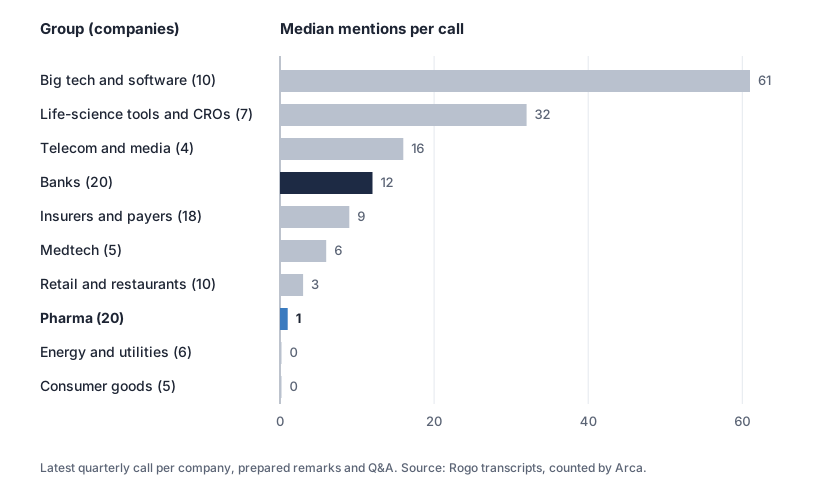
Pharma sits near the bottom, below retail and ahead of only energy and consumer goods. Nine of the 20 largest pharma companies never said AI on their latest call: Merck, Johnson & Johnson, Lilly, AbbVie, GSK, Novo Nordisk, Gilead, Regeneron and Vertex. Three companies account for 70% of pharma's 55 mentions: Roche (16), Sanofi (14) and Bristol Myers Squibb (9). The rest of the group is at 3 or fewer.
| Pharma company | AI mentions on latest call |
|---|---|
| Roche | 16 |
| Sanofi | 14 |
| Bristol Myers Squibb | 9 |
| Pfizer, AstraZeneca, Novartis, Bayer | 3 each |
| Amgen, Takeda, Moderna, Biogen | 1 each |
| Merck, J&J, Lilly, AbbVie, GSK, Novo Nordisk, Gilead, Regeneron, Vertex | 0 |
Roche reports sales, not full earnings, in Q3, so we used its Q3 sales call. Takeda's call is its fiscal Q2. Moderna had not held its Q3 call by 5 November, so its row is Q2.
Pharma's mentions rose tenfold, from a low base
We repeated the count for the same 10 pharma companies and 10 banks across eight quarters. Pharma started near zero. Banks started low and kept climbing, so the ratio narrowed while the absolute gap widened.
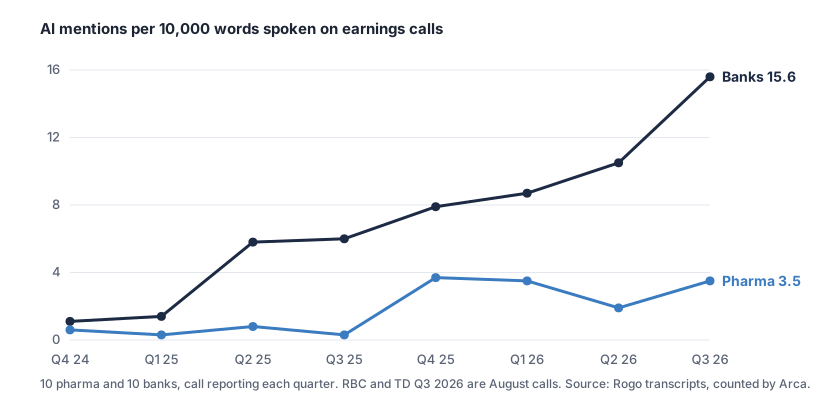
Pharma's mention rate rose about tenfold in a year, from 0.3 in Q3 2025 to 3.5 in Q3 2026. Banks went from 6.0 to 15.6. The pharma jump comes from a few companies. Pfizer had 31 mentions on its Q4 2025 call and between 2 and 6 on every other call we counted. Roche had 27 in Q1 2026.
The J.P. Morgan Healthcare Conference is where pharma executives present to investors in January, and we expected more AI talk there. We found 23 mentions across 19 pharma transcripts, about 2.0 per 10,000 words. That is no higher than on earnings calls, and 9 of the 19 never used the word. Roche had no transcript.
Pharma talks about AI as science, banks as business
We sorted every AI mention by the function it was about.

Pharma's mentions are mostly about research (42%) and internal productivity (25%). Banks talk about customers (22%) and risk and compliance (16%). Pharma mentions AI in a regulatory, quality or safety context once in 55 mentions.
The sectors also frame AI differently.
- Risk. None of pharma's 55 mentions treated AI as a risk. Banks did in 44 of 256 (17%): deposit flight to AI agents, cyber threats, credit exposure to AI borrowers, a slowdown in AI capital spending.
- Governance. AI appeared in the same paragraph as regulation, validation, compliance, privacy or ethics 2 times in pharma (Pfizer and Sanofi) and 27 times at 10 banks. No pharma call links AI to GxP or validation.
- Workforce. 18 pharma mentions at 8 companies tied AI to staff, hiring, training or productivity. At banks the count is 69 at 17 companies. Barclays said it expects about 5,000 fewer full-time staff, with "fewer developers as AI makes our people more productive."
- Who asks. Analysts raised AI 5 times on pharma calls and 65 times on bank calls. Only 4 of 20 pharma calls had an AI question at all. Novartis and Roche deflected the AI part of the question. Sanofi and Bristol Myers Squibb answered it.
Numbers on AI
Four of the 20 pharma companies put a number on AI in a way we could count. Eight of the 20 banks did, with 25 statements between them.
| Company | Statement |
|---|---|
| Roche | 75% of employees are "very active AI users" |
| Bristol Myers Squibb | A target of 20% to 30% shorter drug testing timelines, and half the time from target selection to lead molecule |
| Sanofi | 2 points of one-off Q3 sales growth, "partly linked" to AI-assisted data tools |
| Bayer | A year earlier to patients for one drug (the CEO later said most of that came from the operating model, not AI) |
| Bank of America | About 130 AI projects, benefits of 2 to 3 times the expense, and a pipeline going from $250 to $300 million this year to $700 million next year |
| Citi | 14,000 engineers on one AI coding tool, new products launched 30% to 40% faster, tech vendor spend down 30% |
| TD | A $200 million fiscal 2026 value target from AI, essentially reached |
| RBC | A target of $700 million to $1 billion of enterprise value by the end of fiscal 2027 |
The pharma numbers are time-to-market targets. The bank numbers are costs, savings or headcount.
Partners show the same pattern. Five pharma companies named an AI partner on their latest call: Bristol Myers Squibb (Anthropic, NVIDIA and Tempus), Sanofi (Recursion and Owkin), Takeda (EnsoData), and Roche and Moderna on earlier calls. None gave a compute or capital figure. Four banks named a partner (Citi, Morgan Stanley, Goldman Sachs and RBC). The banks that gave compute or spending figures mostly quoted the whole market, such as Goldman's estimate of more than $10 trillion of US data-center investment through 2032.
Possible reasons pharma says less
We did not test why. One guess is that pharma value shows up in the pipeline, not in a cost line an analyst asks about. Another is that a public claim about AI at a regulated company needs legal review before an executive makes it.
Press releases show more activity than the calls do. We counted about 40 AI partnerships announced by 16 large pharma companies since January 2025. The most frequent partners are the OpenFold3 data-sharing consortium (AbbVie, Bristol Myers Squibb, Takeda and Johnson & Johnson), NVIDIA (Lilly, Roche and Novo Nordisk) and Iambic (AbbVie, Takeda and Bayer). Novo Nordisk announced the most, with NVIDIA, OpenAI, AWS and Anthropic.
AI leaders: titles in seat
We searched current job titles for a director or above with AI in the title.
| Group | Has an AI leader | Has an enterprise head or Chief AI Officer |
|---|---|---|
| Top 20 pharma | 95% (19 of 20, all but Moderna) | 55% |
| Top 20 banks | 90% | 75% |
| Top 20 insurers | 85% | 55% |
| All pharma with 1,000+ job postings (59) | 63% | 34% |
| All banks with 1,000+ job postings (75) | 87% | 51% |
Among sectors with 1,000+ postings, the share with an AI leader is 100% in tech, 88% in consumer goods, 81% in industrials, 80% in autos, 77% in telecom, 62% in energy and 61% in retail.
At the top 20, pharma looks like banks. Below the top 20, it does not: 63% of mid-sized pharma companies have an AI leader against 87% of banks. Lilly, Regeneron and Boehringer Ingelheim have a Chief AI Officer. Among the banks, JPMorgan, HSBC, US Bancorp, Truist, Santander and ING do.
"Enterprise head" means a Chief AI Officer, a Chief Data and AI Officer, or a global or group head of AI. The Clay search returns at most 25 people per company, so a title we missed counts as absent.
Hiring: AI roles and AI skills
We looked at how many postings have an AI title and how many regulatory, quality or compliance roles ask for AI skills.
| Group (companies) | AI-titled postings, median / pooled | Regulatory, quality or compliance roles asking for AI skills | Companies with a head-of-AI style posting |
|---|---|---|---|
| Pharma (59) | 1.1% / 1.9% | 3.0% | 59% |
| Banks (75) | 2.0% / 2.6% | 6.8% | 71% |
| Insurers (44) | 1.7% / 1.9% | 3.3% | 64% |
| Medtech (30) | 0.5% / 0.9% | 1.8% | 47% |
| CROs and tools (23) | 1.0% / 0.8% | 1.8% | 48% |
Banks post somewhat more AI-titled jobs (2.6% against 1.9% pooled), and the gap in regulatory roles is wider. Banks ask for AI skills in compliance and risk roles 6.8% of the time, pharma 3.0% in regulatory, quality and GxP roles. The role definitions differ by sector, so this is a comparison of similar functions, not identical jobs. Pfizer is the outlier: 25.5% of its regulatory and quality postings ask for ChatGPT or Copilot experience.
Across the whole industry, the picture is similar. We counted the share of employers with 1,000 or more staff that posted at least one AI, machine learning, generative or agentic job in the last 90 days.
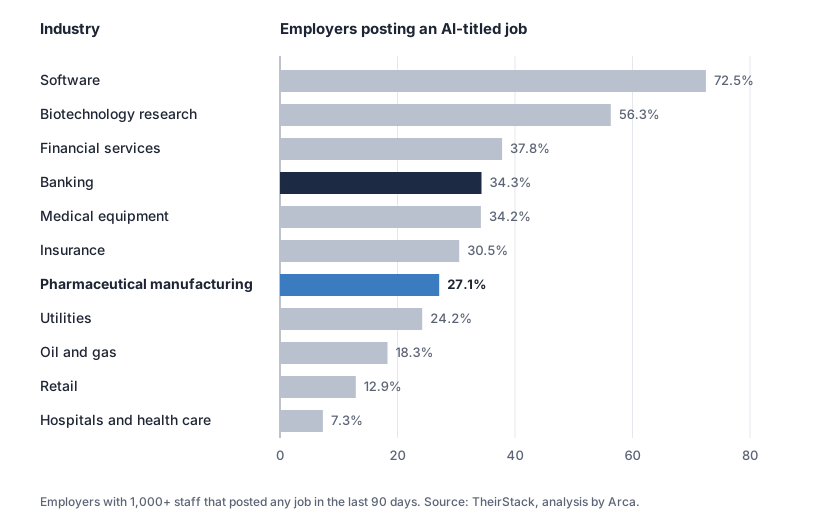
Biotech research is at 56%, above banking. Pharmaceutical manufacturing is at 27%, below it, and the industry tag is noisy: LinkedIn files some retailer pharmacies under pharma, which pulls the share down. Treat 27% as a floor. Pharma manufacturing also posts head or director of AI style titles at 1.45 per 1,000 postings, level with financial services at 1.39.
Hiring and talk do not match
We checked 12 large pharma companies directly on their own careers sites and compared the share of open jobs with an AI title to the AI mentions on their latest call.
| Company | Open jobs | AI-titled | Share | AI mentions on call |
|---|---|---|---|---|
| Eli Lilly | 649 | 31 | 4.8% | 0 |
| Novartis | 858 | 41 | 4.8% | 3 |
| AstraZeneca | 1,375 | 56 | 4.1% | 3 |
| Bristol Myers Squibb | 637 | 22 | 3.5% | 9 |
| Pfizer | 610 | 20 | 3.3% | 3 |
| Merck | 900 | 26 | 2.9% | 0 |
| GSK | 944 | 27 | 2.9% | 0 |
| Roche | 1,277 | 34 | 2.7% | 16 |
| Novo Nordisk | 467 | 9 | 1.9% | 0 |
| Johnson & Johnson | 1,623 | 25 | 1.5% | 0 |
| Sanofi | 1,069 | 13 | 1.2% | 14 |
| AbbVie | 1,713 | 18 | 1.1% | 0 |
Lilly has the highest share of AI jobs and no mentions. Merck and GSK sit mid-table with none. Sanofi has one of the lowest shares and 14 mentions. What a company says on a call tells you little about what it is hiring for. The AI-title share matched the third-party data within 1 point for 10 of the 12 companies. Roche read 1.1 points lower on its own site and Novartis 1.1 higher.
Use cases by industry
Each row below comes from a company filing or release.
| Sector | Area | Example |
|---|---|---|
| Pharma | Discovery | AstraZeneca says 90% of its small-molecule discovery pipeline is AI-assisted (2025 Annual Report) |
| Pharma | Trials | GSK says digital twins and machine learning cut patient numbers by up to 15% without losing statistical power (2025 Annual Report) |
| Pharma | Documents | Merck cut a first draft of a clinical study report from 2 to 3 weeks to 3 to 4 days, and the time to a fully human-reviewed draft from 180 to 80 hours (Merck release, 25 June 2025) |
| Pharma | Manufacturing | GSK uses generative AI to review historical investigation data at more than 20 sites (2025 Annual Report) |
| Banks | Code | Wells Fargo reports 35% more code written (2025 Annual Report) |
| Banks | Credit | TD's credit tool cut a first-draft credit memo from up to 3 working days to under 30 minutes, and 95% of outputs passed expert review on 220 test deals (TD release, 22 October 2026) |
| Insurers | Underwriting | Ping An underwrote 94% of life policies in seconds in the first half of 2026 (2026 interim results) |
The money
Banks and insurers publish returns on AI.
- Bank of America: about 130 AI projects, each paying back 2 to 3 times its cost (Q3 2026 call, 14 October 2026).
- RBC: a target of $700 million to $1 billion of enterprise value by the end of fiscal 2027.
- Manulife: $1 billion of cumulative AI value by 2027, with $300 million reached by the end of 2025 (release, 13 October 2026).
- Zurich: $78 million in AI and automation savings at Farmers, against a $100 million target set at its 2024 investor day (Investor Update, 18 November 2025). The slide does not say whether the figure is cumulative.
- Aviva: over £90 million of claims cost savings (2025 Annual Report). A separate figure of over £60 million for motor claims appears in its 2024 results, so the two are not a single series.
- BNP Paribas Fortis: AI tools produced the output of 370 full-time employees by June 2026.
We found no equivalent for pharma. None of Novartis, Sanofi, Pfizer, Lilly, Bristol Myers Squibb, AbbVie, Takeda or Novo Nordisk discloses AI spend as a share of R&D or IT. Their R&D budgets are public, but AI is not broken out. Pharma also reports value differently: a faster trial or a better molecule shows up in the pipeline, not on a cost line.
AI and GxP work
GxP stands for the "good practice" rules that govern manufacturing, laboratory, clinical and distribution work: GMP, GLP, GCP and GDP. Any software that touches a record under those rules has to be validated like process equipment, which is why computer system validation exists. Banks face regulators too. The difference is that a GMP record is a fixed, inspected document, and an AI tool that writes or changes one has to be shown to do so reliably.
The clearest rule is a draft. The European Commission's draft GMP Annex 22, published in July 2025, says it "does not apply to Generative AI and large language models (LLM), and such models should not be used in critical GMP applications." For non-critical use it requires qualified staff to confirm the output. At a 30 June 2026 workshop, EMA discussed allowing LLMs under a documented, risk-based control strategy. We found no decision as of August 2026.
Other rules are softer.
- FDA and EMA. On 14 January 2026 the two agencies published ten guiding principles for good AI practice in drug development. They are non-binding, human-centric and risk-based, and cover nonclinical, clinical, post-marketing and manufacturing work.
- FDA draft guidance. The January 2025 draft sets a credibility assessment framework for AI that supports regulatory decisions about drugs. It excludes drug discovery and internal operational tools.
- A survey of practice. A UK MHRA-supported survey in the International Journal of Pharmaceutics (volume 701, August 2026) found 6% of responses used AI in cGMP or GDP environments and 69% were considering it. The sample is 26 industry respondents, and the authors say it is not representative.
- A company example. Novo Nordisk's 25,000-user generative AI tool is for non-regulated processes only.
- Inspections. A panelist at the ISPE Annual Meeting said regulators plan to assess firms against their own AI policies (Pharmaceutical Technology, 4 November 2026). That is one panelist's statement, not an agency position.
The regulators themselves moved first. FDA launched its internal generative AI tool Elsa on 2 June 2025 and reported on 1 December 2025 that more than 70% of staff used it. Elsa 4.0 reached all staff on 6 May 2026. EMA runs an AI workplan to 2028 and has not published a usage count.
For regulatory and quality teams
Work that is heavy on documents and is not itself a GMP record moves first: drafting, summarizing, comparing and checking. Merck's clinical study report result is the proof point. For the evidence on how well current models do regulatory tasks, see our LifeSci Diamond benchmark of 55 regulatory affairs tasks.
Our reading is that the easiest place to start is work that already ends in human review. That is also the pattern the draft Annex 22 allows for non-critical use. Teams that want to move into GxP records will need validation evidence for the whole tool, not for the model alone.
Method and limits
- Disclosure bias. Figures on staff use, returns and use cases come from companies that chose to publish them. They skew toward leaders. This is a benchmark, not a ranking.
- Metrics differ. Use, weekly use, access and training are different things. We label each one.
- Earnings calls. Counts are exact for the word "AI" and the phrase "artificial intelligence", checked by hand against full transcripts for Merck and Lilly. The calls cover one quarter per company. RBC and TD are August calls, Roche is a sales call, and Moderna is Q2. Rogo's counts for banks in 2024 disagree between two adjacent quarters, so we do not chart Q3 2024.
- Titles. Clay is a snapshot of current job titles and returns at most 25 people per company. Missing a title lowers the share.
- Hiring. A posting is not a hire. Shares are more stable than counts. We checked TheirStack against the careers sites of 12 large pharma companies: shares matched within 1 point for 10, the ranking correlated at 0.80, and the three lowest were the same on both lists. Absolute counts did not match, because the careers site shows only open jobs and TheirStack includes reposts over 90 days. For that reason we use shares.
- Job-posting terms. We matched AI skills with specific terms, such as generative AI, ChatGPT, Copilot, machine learning, LLM and agentic. We removed recruiting boilerplate such as "AI-powered biopharma company."
- Coverage. Only 59 of 146 pharma domains had 1,000 or more job postings. The rest were mostly small biotechs and are not in the company-level shares.
- Role definitions. Pharma regulatory, quality, GxP and validation roles are not the same as compliance, risk and audit roles at a bank or insurer.
- Primary sources. We dropped figures we could not trace to a primary document, including a 96.8% figure attributed to China Life and an AstraZeneca digital-assistant claim from a conference transcript we could not find.
FAQ
What percent of pharma companies use AI?
Among the large companies that disclose it, 63% to 80% of staff use AI: Takeda 63.4% (generative AI, March 2026), Roche 75% (weekly), Merck above 80%. In our hiring data, 27% of pharmaceutical manufacturers with 1,000 or more staff and 56% of biotech research employers posted an AI-titled job in the last 90 days.
Is pharma behind banks on AI?
On staff use and AI leaders at the top companies, no. On public talk, published returns and AI skills in regulatory roles, yes. The median top-20 pharma company mentioned AI once on its latest earnings call. The median bank mentioned it 12 times.
Can generative AI be used in GxP?
Not for critical GMP applications under the draft EU Annex 22, which says such models should not be used there. For non-critical use, the draft requires qualified staff to confirm the output. The draft is not final, and EMA has discussed allowing LLMs under a documented risk-based control strategy.
What is GxP?
GxP covers good manufacturing, laboratory, clinical and distribution practice. Software that creates or changes records under these rules has to be validated like process equipment.