
Surrogate Endpoints Explained Through CAST and ACCORD

A surrogate endpoint is a measured number, such as a count of extra heartbeats or a cholesterol value, that a trial uses in place of the outcome patients care about. Each one is a bet that the number and the outcome move together when a drug changes the number, and some of the best-known trials in medicine are that bet losing. In the 1989 report of the Cardiac Arrhythmia Suppression Trial (CAST), two drugs removed extra heartbeats after heart attacks, and the patients taking them died at more than twice the placebo rate, 7.7% against 3.0%. In ACCORD, driving the blood sugar marker HbA1c below 6.0% in people with type 2 diabetes led to more deaths than a standard target did. We think the lesson matters more as models get better at predicting biomarkers, because a model that predicts a marker accurately says nothing about whether changing the marker changes the outcome.
This guide retells both trials from the original papers, adds a cholesterol failure and two markers that held up, explains how FDA classifies surrogate endpoints, and ends with what follows for a team that predicts biomarkers with a model.
A surrogate endpoint is a bet that a marker and an outcome move together
FDA defines a surrogate endpoint as a trial endpoint "used as a substitute for a direct measure of how a patient feels, functions, or survives." The statute, section 507(e)(9) of the Federal Food, Drug, and Cosmetic Act (FD&C Act), added by the 21st Century Cures Act, defines it as a marker, such as a laboratory measurement or radiographic image, that is not itself a direct measurement of clinical benefit and either is known to predict clinical benefit or is reasonably likely to.
Teams use markers because outcomes are slow to observe. FDA's own example is blood pressure: many trials of different blood pressure drugs showed that lowering systolic pressure lowered the risk of stroke, so a trial of a new drug can measure blood pressure and run faster in fewer patients. The same page says FDA approved 45 percent of new drugs between 2010 and 2012 on a surrogate endpoint.
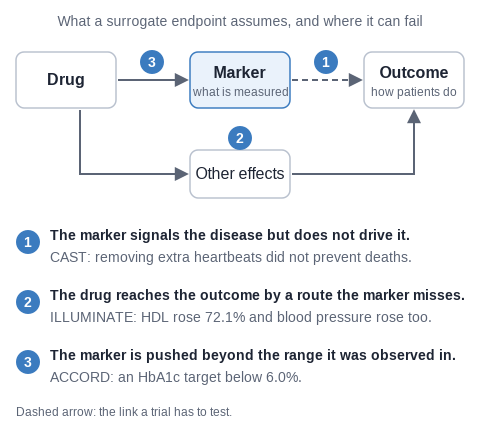
Blood pressure works because the relationship has been tested by intervention many times. Most markers start from something weaker: patients with extra heartbeats after a heart attack are at higher risk of sudden death, or patients with high HbA1c have more cardiovascular events, and the correlation suggests that lowering the number should help. But a correlation shows only that the number tracks risk, whereas a drug lowers it by acting on the body, which can respond in ways the observation never sampled. Figure 1 shows where the chain from drug to outcome can break.
CAST removed the arrhythmia marker and patients died more often
Premature ventricular beats in heart attack survivors were a known risk factor for sudden death, as the CAST investigators wrote in 1989, but nobody knew whether suppressing them reduced that risk. Encainide and flecainide suppressed the beats. Kim Branson writes in his November 2026 essay "Colorless Green Ideas in Medicine" that the logic felt so obvious that many doctors questioned randomizing patients to placebo. CAST tested it anyway.
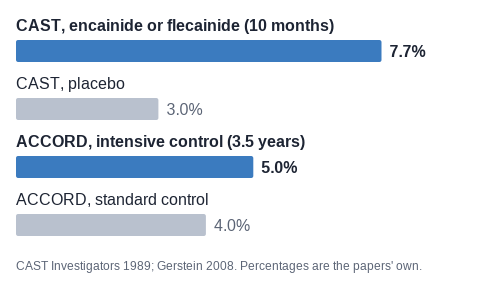
Patients first went through a titration phase to find a drug that suppressed their arrhythmia, which the 1991 paper defines as at least 80 percent fewer premature beats and 90 percent fewer runs of tachycardia on a Holter recording, a portable heart-rhythm monitor. Only patients who responded were randomized, and by March 30, 1989, 1,727 of the 2,309 patients who entered titration, 75%, had been suppressed and randomized. In that preliminary report, 56 of 730 patients on encainide or flecainide had died after an average of 10 months, 7.7%, against 22 of 725 on placebo, 3.0% (Figure 2), and the investigators stopped that part of the trial. They concluded that the drugs should not be used in this setting "even though these drugs may be effective initially in suppressing ventricular arrhythmia."
The fuller analysis by Echt and colleagues in 1991 covers 1,498 patients, 755 on encainide or flecainide and 743 on placebo, followed for a mean of 10 months. It counts deaths and resuscitated cardiac arrests together. Of the 89 such events, 59 were due to arrhythmia, 43 on drug and 16 on placebo (P = 0.0004), 22 to other cardiac causes, 17 and 5, and 8 to noncardiac causes, 3 and 5, so 63 patients on drug and 26 on placebo, or 8.3% against 3.5%, died or were resuscitated (relative risk 2.38, 95% confidence interval 1.59 to 3.57). Nonlethal events such as recurrent heart attack, heart failure and angina did not differ between the groups, so the drugs did what the marker promised and the patients who took them still did worse. The authors wrote that the mechanisms behind the excess mortality "remain unknown."
Branson reads the result as the suppression of an electrical correlate of scarred heart muscle, which then destabilized the muscle the drugs were meant to protect. The papers do not claim that mechanism, so we read CAST more narrowly: a marker that predicts who will die in untreated patients can still be the wrong thing to treat, and a drug needs an outcome trial or a surrogate already tested against outcomes for its class.
ACCORD pushed a marker that predicts complications and mortality rose
The ACCORD paper begins from the observation that higher glycated hemoglobin goes with more cardiovascular events in type 2 diabetes. Its authors asked whether treating toward a normal value would reduce them, and randomized 10,251 patients, 5,128 to intensive therapy and 5,123 to standard therapy, with a median baseline HbA1c of 8.1%. The intensive target was below 6.0% and the standard target was 7.0% to 7.9%. At one year the medians were 6.4% and 7.5%, so the marker moved as intended.
The outcomes did not follow. The primary composite of nonfatal heart attack, nonfatal stroke and cardiovascular death occurred in 352 intensive-arm patients and 371 standard-arm patients (hazard ratio 0.90, 95% confidence interval 0.78 to 1.04), a difference that could be chance. All-cause death was 257 against 203 (hazard ratio 1.22, 1.01 to 1.46), or 1.41% against 1.14% a year, with cardiovascular deaths at 135 against 94, and the higher mortality led to the discontinuation of intensive therapy after a mean of 3.5 years. Nonfatal heart attacks went the other way, 186 against 235, and hypoglycemia requiring medical assistance affected 10.5% of the intensive group against 3.5%.
ACCORD tested a treatment strategy and not a single drug, so the authors could not separate the target from the combinations of drugs used to reach it. They write that the harm "may be due either to the approach used for rapidly lowering glycated hemoglobin levels or to the levels that were achieved." The second explanation is point 3 of Figure 1, a marker pushed below the range where its relationship to outcomes had been observed; the first is not a failure of the marker at all, and the trial cannot say which is right.
The ADVANCE trial, reported by Patel and colleagues in the same journal in 2008, shows that HbA1c predicts some outcomes. It randomized 11,140 patients to an intensive strategy aiming for an HbA1c of 6.5% or less, and the groups reached 6.5% and 7.3% over a median of 5 years. Major microvascular events fell from 10.9% to 9.4% (hazard ratio 0.86, 0.77 to 0.97), mostly because of nephropathy, which fell from 5.2% to 4.1%. Macrovascular events (hazard ratio 0.94, 0.84 to 1.06) and death (hazard ratio 0.93, 0.83 to 1.06) did not change significantly, and severe hypoglycemia rose from 1.5% to 2.7%. HbA1c therefore has trial support as a marker of kidney outcomes and none as a marker of survival in these two trials, and a sponsor that cites it should say which outcome it has been tested against.
Branson ties both stories to what he calls the tyranny of simplicity: regulatory pathways, clinical guidelines and billing codes reward a single marker with a single cutoff, because one test with one threshold is easier to order, reimburse and codify than a validated panel. That is his argument about incentives, which the trials do not test; every number here comes from the trial papers, and we did not audit the other citations in his essay.
Torcetrapib raised HDL cholesterol by 72% and patients did worse
Observational epidemiology linked higher HDL cholesterol to lower cardiac risk, as Branson summarizes, and the ILLUMINATE trial shows a way a marker can fail that differs from CAST and ACCORD. Torcetrapib inhibits cholesteryl ester transfer protein (CETP), which raises HDL cholesterol and lowers LDL cholesterol. In the trial, 15,067 patients at high cardiovascular risk received torcetrapib plus atorvastatin or atorvastatin alone. At 12 months HDL cholesterol was up 72.1% and LDL cholesterol down 24.9% from baseline in the torcetrapib group.
The same patients also had a 5.4 mm Hg rise in systolic blood pressure and changes in potassium, sodium, bicarbonate and aldosterone. The trial was terminated early because of an increased risk of death and cardiac events. Cardiovascular events had a hazard ratio of 1.25 (1.09 to 1.44) and death from any cause 1.58 (1.14 to 2.19). Post hoc analyses found more deaths in patients whose potassium fell or bicarbonate rose by more than the median. The authors concluded that the mechanism was unknown, that there was evidence of an off-target effect, and that harm from CETP inhibition itself could not be ruled out. Point 2 of Figure 1, a drug reaching the outcome by a route the marker does not measure, is therefore a reading the authors support but do not prove.
A second CETP inhibitor gives a comparison. In REVEAL, 30,449 patients on intensive atorvastatin received anacetrapib or placebo for a median of 4.1 years. At the trial midpoint HDL cholesterol was 104% higher in the anacetrapib group and non-HDL cholesterol 18% lower, and major coronary events occurred in 10.8% against 11.8% (rate ratio 0.91, 0.85 to 0.97). An earlier trial of 1,623 patients had found no change in blood pressure, electrolytes or aldosterone with anacetrapib through 76 weeks. Because anacetrapib moved HDL and non-HDL cholesterol together, REVEAL cannot say which change produced the lower event rate. Branson makes the same point and adds that across these trials the size of the HDL rise has been a poor guide to benefit.
LDL cholesterol held up because statins and a PCSK9 antibody lowered it and outcomes followed
LDL cholesterol earned its standing through repetition. The Cholesterol Treatment Trialists' Collaboration pooled individual data from about 170,000 participants in 26 randomized statin trials, five of more against less intensive treatment and 21 of statin against control. It found a rate ratio of 0.78 (0.76 to 0.80) for major vascular events per 1.0 mmol/L reduction in LDL cholesterol, and all-cause mortality fell by 10% per 1.0 mmol/L (rate ratio 0.90, 0.87 to 0.93).
In FOURIER, evolocumab, a PCSK9 antibody, lowered LDL cholesterol by 59% relative to placebo at 48 weeks in 27,564 patients already taking statins and reduced the primary composite from 11.3% to 9.8% (hazard ratio 0.85, 0.79 to 0.92) over a median of 2.2 years, although cardiovascular death did not change (hazard ratio 1.05, 0.88 to 1.25). The marker moved with two unrelated mechanisms and the outcome followed each time, so a drug acting through a third has two precedents but still needs its own outcome evidence. Torcetrapib shows why, since LDL cholesterol fell 24.9% on it and patients did worse. Figure 3 gives each trial's numbers and source.
- Marker: premature ventricular beats on a Holter recording after a heart attack.
- Tested: encainide or flecainide against placebo, in patients whose arrhythmia a drug had suppressed.
- Size and length: 1,498 patients (755 on drug, 743 on placebo), mean follow-up 10 months.
- Result: death or resuscitated cardiac arrest due to arrhythmia in 43 on drug against 16 on placebo (P = 0.0004); from any cause in 63 against 26 (relative risk 2.38, 95% CI 1.59 to 3.57). Preliminary report: 56 of 730 against 22 of 725 patients had died.
- Outcome: the drug arms were stopped because of excess mortality.
- Source: Echt et al., New England Journal of Medicine 1991; CAST Investigators, 1989.
The marker improved and deaths rose.
- Marker: HbA1c, with an intensive target below 6.0% against a standard target of 7.0% to 7.9%.
- Size and length: 10,251 patients with type 2 diabetes, median baseline HbA1c 8.1%. Intensive therapy was stopped after a mean of 3.5 years.
- Marker result: median HbA1c of 6.4% against 7.5% at one year.
- Primary outcome: nonfatal heart attack, nonfatal stroke or cardiovascular death in 352 against 371 patients (hazard ratio 0.90, 95% CI 0.78 to 1.04).
- All-cause death: 257 against 203 (hazard ratio 1.22, 95% CI 1.01 to 1.46).
- Source: Gerstein et al., New England Journal of Medicine 2008.
HbA1c fell further and deaths rose.
- Marker: HDL cholesterol, with LDL cholesterol as a second marker.
- Tested: torcetrapib plus atorvastatin against atorvastatin alone, in 15,067 patients at high cardiovascular risk.
- Marker result at 12 months: HDL cholesterol up 72.1% and LDL cholesterol down 24.9% from baseline. Systolic blood pressure also rose 5.4 mm Hg, with changes in potassium, sodium, bicarbonate and aldosterone.
- Outcome: cardiovascular events hazard ratio 1.25 (95% CI 1.09 to 1.44); death from any cause hazard ratio 1.58 (95% CI 1.14 to 2.19). The trial was terminated early.
- Source: Barter et al., New England Journal of Medicine 2007, abstract.
HDL rose 72.1% and the trial was stopped.
- Marker: HbA1c, with a target of 6.5% or less.
- Size and length: 11,140 patients with type 2 diabetes, median follow-up 5 years. HbA1c was 6.5% against 7.3%.
- Microvascular events: 9.4% against 10.9% (hazard ratio 0.86, 95% CI 0.77 to 0.97), mostly from nephropathy (4.1% against 5.2%). No significant effect on retinopathy.
- Macrovascular events: hazard ratio 0.94 (95% CI 0.84 to 1.06). Death from any cause: hazard ratio 0.93 (95% CI 0.83 to 1.06).
- Harm: severe hypoglycemia 2.7% against 1.5%.
- Source: Patel et al., New England Journal of Medicine 2008.
The same marker helped the kidneys and left survival unchanged.
- Marker: LDL cholesterol.
- Statins: a meta-analysis of 26 randomized trials and about 170,000 participants found a rate ratio of 0.78 (95% CI 0.76 to 0.80) for major vascular events per 1.0 mmol/L reduction in LDL cholesterol, with similar results in trials of more against less intensive statin treatment (Cholesterol Treatment Trialists' Collaboration, Lancet 2010).
- PCSK9 antibody: in 27,564 patients already on statins, evolocumab lowered LDL cholesterol by 59% relative to placebo and cut the primary composite from 11.3% to 9.8% (hazard ratio 0.85, 95% CI 0.79 to 0.92), over a median of 2.2 years, with no significant change in cardiovascular death (Sabatine et al., New England Journal of Medicine 2017).
Different drugs moved the marker and outcomes followed.
Figure 3. Case files for the trials above, one tab each. Hazard ratios are with 95% confidence intervals.
FDA sorts surrogate endpoints by how much evidence supports them
FDA's Surrogate Endpoint Resources page describes three levels of clinical validation. A candidate surrogate endpoint is still under evaluation for its ability to predict clinical benefit. A reasonably likely surrogate endpoint has strong mechanistic or epidemiologic support, but not enough clinical data to show it is validated, and can support accelerated approval. A validated surrogate endpoint has a clear mechanistic rationale and clinical data providing strong evidence that an effect on the surrogate predicts a specific clinical benefit, and FDA accepts it as evidence of benefit. It adds that validation usually requires clinical trials showing that the surrogate predicts benefit in a context of use.
The phrase context of use carries most of the weight. In its Surrogate Endpoint Table, FDA says the acceptability of a surrogate endpoint is decided case by case and depends on the disease, the patient population, the drug's mechanism of action and the treatments already available, and that an endpoint appropriate in one program should not be assumed appropriate in a different clinical setting. That is the regulatory form of what CAST and ILLUMINATE showed.
FDA publishes the surrogate endpoints that were the basis of approval because section 507 of the FD&C Act requires it to, in four tables that it says it updates every six months. We read the page on November 25, 2026, when it showed "Content current as of: 10/29/2026." The adult non-cancer table has 115 rows, of which 95 are marked for traditional approval, 15 for accelerated approval and 3 for either, with two following other rules, the Animal Rule for an anthrax vaccine and a monograph for antiseptics. Some rows, such as hepatitis D and polycystic kidney disease, are endpoints FDA anticipates could be appropriate but has not yet used to support an approval. The table leaves out endpoints that were once accepted and are no longer, for example one that supported an accelerated approval but whose confirmatory trials failed to show the expected benefit. Figure 4 shows all 15 accelerated rows and 12 traditional ones, and can be filtered by approval type.
| Disease or use | Surrogate endpoint | Approval type |
|---|---|---|
| Alzheimer's disease | Reduction in amyloid beta plaques | Accelerated |
| Anticoagulation reversal (needed due to life-threatening or uncontrolled bleeding) | Percent change in anti-FXa activity, from baseline to nadir | Accelerated |
| Arginase 1 deficiency | Reduction in plasma arginine | Accelerated |
| Chikungunya vaccine | CHIKV-specific neutralizing antibody | Accelerated |
| Duchenne muscular dystrophy (DMD) | Skeletal muscle dystrophin | Accelerated |
| Fabry disease | Reduction of GL-3 inclusions in biopsied renal peritubular capillaries (using the BLISS methodology) | Accelerated |
| Hepatitis D Virus (HDV) | ≥ 2 log reduction in HDV-RNA plus normalization of ALT or HDV below the LLOQ | Accelerated |
| Influenza A and B vaccines, persons 65 and older | Hemagglutination inhibition antibody | Accelerated |
| Metabolic dysfunction associated steatohepatitis (MASH) | Histopathologic findings of either 1) resolution of steatohepatitis with no worsening of fibrosis OR 2) improvement of fibrosis with no worsening of steatohepatitis OR 3) both | Accelerated |
| Methemoglobinemia | Serum methemoglobin | Accelerated |
| Mycobacterium avium complex (MAC) lung disease | Sputum culture conversion to negative by six months | Accelerated |
| Polycystic kidney disease | Total kidney volume | Accelerated |
| Preterm birth | Delivery prior to 37 weeks gestation | Accelerated |
| Primary biliary cholangitis | Serum alkaline phosphatase and bilirubin | Accelerated |
| Pulmonary tuberculosis | Sputum culture conversion to negative | Accelerated |
| Asthma | Forced expiratory volume in 1 second (FEV1) | Traditional |
| Chronic kidney disease | Estimated glomerular filtration rate or serum creatinine | Traditional |
| Gout | Serum uric acid | Traditional |
| Human immunodeficiency virus-1 (HIV-1) | Undetectable plasma HIV RNA | Traditional |
| Hepatitis C virus (HCV) | Sustained viral response (HCV-RNA) | Traditional |
| Hypercholesterolemia | Serum LDL cholesterol | Traditional |
| Hypertension | Blood pressure | Traditional |
| Hypothyroidism | Serum thyroid-stimulating hormone (TSH) | Traditional |
| Osteoporosis, men | Bone mineral density, after efficacy based on new morphometric vertebral fractures has been established in postmenopausal women | Traditional |
| Osteoporosis, postmenopausal women | New morphometric vertebral fractures | Traditional |
| Phenylketonuria | Plasma phenylalanine | Traditional |
| Type 2 diabetes mellitus | Serum hemoglobin A1C | Traditional |
27 of 27 shown
The traditional rows include blood pressure, LDL cholesterol and, for type 2 diabetes, HbA1c, while the accelerated rows are the explicit bets, such as amyloid beta plaque reduction in Alzheimer's disease and skeletal muscle dystrophin in Duchenne muscular dystrophy. For osteoporosis in postmenopausal women, FDA lists new morphometric vertebral fractures as the endpoint, and it lists bone mineral density for men only after efficacy based on those fractures has been established in postmenopausal women. So a marker is accepted in a new population only after the outcome has been shown in the first.
HbA1c stayed on the list after ACCORD, and FDA handled cardiovascular safety in separate guidance. In December 2008 FDA announced guidance, for immediate implementation, on how to show that a new type 2 diabetes therapy is not associated with an unacceptable increase in cardiovascular risk. The notice does not mention ACCORD, which had stopped its intensive arm earlier that year. In March 2020 FDA announced that it was withdrawing the 2008 guidance in favor of a draft on evaluating the safety of new drugs for glycemic control, which FDA's page still lists as a draft not for implementation.
Accelerated approval is the pathway for markers that are only reasonably likely to work. Under section 506(c) of the FD&C Act, FDA may approve a drug on a surrogate endpoint that is reasonably likely to predict clinical benefit, or on a clinical endpoint measurable earlier than irreversible morbidity or mortality. The sponsor may be required to conduct a postapproval study to verify and describe the predicted effect, and FDA's accelerated approval page says that if a confirmatory trial does not show benefit, FDA has regulatory procedures that could lead to removing the drug from the market.
Congress tightened the pathway in the Consolidated Appropriations Act, 2023, which amended section 506(c) so that FDA may require a confirmatory study to be underway before approval and may withdraw an approval by expedited procedures if the sponsor fails to conduct the study with due diligence or the study does not verify the benefit. FDA has since published two draft guidances. The first, announced on December 6, 2024, covers its approach to accelerated approval, and the second, from January 2025 under docket FDA-2024-D-3334, covers what makes a confirmatory trial underway. FDA's page for the first and its page for the second both list them as drafts with non-binding recommendations, and a Federal Register notice of February 6, 2026 still calls the first a draft. We found no notice finalizing either as of November 25, 2026. For a developer, a reasonably likely marker can bring earlier approval only if the confirmatory trial is planned alongside it, because FDA may now require that trial to be underway first.
A model that predicts a biomarker adds a second bet to the first
Models now predict markers such as how a cell's gene activity changes after a perturbation or how a molecule is absorbed and how toxic it is, and our guide to biological foundation models describes several of them. A team that uses one is making two bets in a row, that the model predicts the marker and that the marker predicts the outcome. A model's accuracy is measured against held-out values of the marker, so it tests the first bet and says nothing about the second, and a better model improves only the first.
Better prediction makes the second bet more consequential. When a model ranks a large library of candidates by predicted marker effect, the candidates at the top are the ones predicted to move the marker furthest. That echoes ACCORD, where the intensive arm drove HbA1c to 6.4% against 7.5%, and ILLUMINATE, where torcetrapib scored very well on HDL cholesterol and acted through blood pressure and electrolytes that the marker did not capture.
Branson makes a related point about the volume of ideas: an AI agent given a differentially expressed gene and a chronic indication returns, thirty seconds later, a citation-dense target dossier with pathway mechanisms and biomarker plans in which every sentence obeys biomedical grammar and the gaps are easy to miss. A fluent marker plan is not a validated one, so before relying on a predicted biomarker we would ask what FDA asks of a surrogate.
- Which level of validation the marker holds for this disease and population, which FDA's table answers for many cases: LDL cholesterol is listed for hypercholesterolemia, and HDL cholesterol is not listed at all.
- What outcome evidence exists for drugs that move it by different mechanisms. LDL has statins and evolocumab, while HDL has a harmful trial and a 9% benefit.
- Whether safety markers beyond the target were measured alongside it, because ILLUMINATE's 5.4 mm Hg blood pressure rise was in the trial's own data.
- Whether the model's accuracy for the marker is reported separately from the evidence linking the marker to the outcome, so a reader can see which bet each number supports.
FDA's January 2025 draft guidance on AI in regulatory decision-making proposes a credibility framework in which a sponsor defines the question the model answers and its context of use and matches the evidence to the risk of a wrong decision, which we summarize in our post on that guidance. The draft does not cover AI used in drug discovery, so it reaches a predicted biomarker only when the prediction itself is submitted as evidence about safety, effectiveness or quality. Even then the model cannot supply the marker-to-outcome link, which for a marker that is only reasonably likely to predict benefit is left to a confirmatory trial after approval.
Frequently asked questions
What is a surrogate endpoint?
A marker, such as a lab value or an image, that a trial uses in place of a direct measure of how patients feel, function or survive. FDA accepts it when it is known to predict clinical benefit, or for accelerated approval when it is reasonably likely to.
What is the difference between a biomarker and a surrogate endpoint?
A biomarker is any objectively measured indicator of a biological process or response to a treatment. It becomes a surrogate endpoint only when a trial uses it to stand in for a clinical outcome, which FDA describes as a small subclass of biomarkers.
Does FDA still approve drugs on surrogate endpoints?
Yes. FDA says it approved 45 percent of new drugs between 2010 and 2012 on a surrogate endpoint, and its table lists 115 adult non-cancer rows. Endpoints that are only reasonably likely to predict benefit support accelerated approval and need confirmatory evidence.
Sources and limits
All pages were read on November 25, 2026. We read the full text of CAST 1991, ACCORD, ADVANCE, REVEAL, FOURIER, the Cholesterol Treatment Trialists' meta-analysis and the 1,623-patient anacetrapib trial, the last from an archived copy of the journal page. For CAST 1989 and ILLUMINATE the journals show only the abstract without a subscription, so those numbers are abstract-level; the authors' 2012 reanalysis of ILLUMINATE repeats its two hazard ratios. The CAST bars in Figure 2 are the 1989 abstract's own percentages, and the ACCORD bars are the paper's. FDA material comes from its Surrogate Endpoint Resources page (content dated 07/24/2018), its Surrogate Endpoint Table (current as of 10/29/2026; we counted the rows and abridged them for Figure 4), its accelerated approval page (current as of 11/19/2026), the draft guidance pages and Federal Register notices linked above and the statute. We did not read either accelerated approval draft in full. We read all of Branson's essay, dated November 23, 2026 with a correction note dated November 24, and used it for his argument and no number. The reasoning about predicted biomarkers is our opinion and not an FDA position, and we have not run any of the models mentioned.