
Pharma Data Sharing for AI Without Moving the Data

The data that would most improve drug-discovery models sits inside individual companies, so the strategic question is how a company lets a model learn from its measurements without letting the measurements go. Three arrangements are now in use. In a give-to-get consortium, members contribute anonymized measurements to a shared pool. In a federated network, members train on their own data and send only model updates to be combined. In an exclusive fine-tune, a company pays a model developer to adapt a shared base model on its private history, and only that company receives the result. Each trades privacy, accuracy and control differently, and we think the public evidence that any of them pays off is thinner than the announcements suggest, because the largest reported gains come from the organizers and are measured on the members' own data.
Everything below comes from public sources. Where a number comes from a company or consortium, the sentence says so and links the page.
The data that would improve the models is held by competitors
Apheris sells federated training, and its argument is that public data no longer suffices. Its chief executive and co-founder, Robin Roehm, said when an Apheris-run consortium was announced in March 2025 that "Public data is hitting its limit." The size of the private holdings shows what is at stake. The ten companies in MELLODDY, a federated project funded by the EU's Innovative Medicines Initiative, report in a 2023 paper that their combined holdings came to more than 2.6 billion confidential activity data points across more than 21 million compounds and more than 40,000 assays. Apheris reports in its AI Structural Biology write-up that five pharmaceutical companies used 20,167 private protein-ligand structures in one fine-tuning run. These counts measure different things and do not convert into one another.
Public efforts exist because that gap is visible. OpenBind is a UK-led collaboration coordinated by Diamond Light Source to generate protein-ligand data openly. Its first-release preprint on bioRxiv, posted on 1 September 2026, reports 925 crystallographic binding events from 699 compounds against one viral enzyme, the enteroviral 2A protease, with affinity measurements for 601 of the compounds, and calls this, to the authors' knowledge, the largest public single-target experimental structure-affinity dataset. The Diamond release of 5 May 2026 describes OpenBind as "the first initiative to generate these essential datasets at industrial scale, openly and continuously." The ASAP Discovery consortium, OpenADMET and the Polaris platform also ran a blind challenge on previously undisclosed data from ASAP's SARS-CoV-2 and MERS-CoV main-protease programs. The organizers' outcome paper in the Journal of Chemical Information and Modeling (February 2026) reports 66 participants and 381 submissions, and the raw challenge data are on Zenodo under a CC BY 4.0 license. These public datasets are far smaller than the private holdings above.
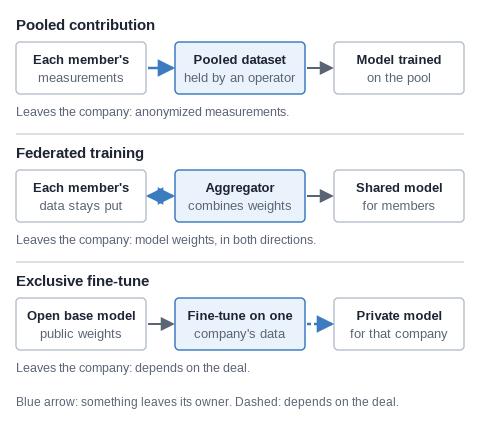
The structures differ in what leaves the company (Figure 1).
Pooling gives the most data and asks members to trust an operator
A pool is the simplest design and the one that exposes the most. Inductive Bio builds models of ADMET properties (absorption, distribution, metabolism, excretion and toxicity) and runs a consortium that Drug Target Review described in July 2025 as a "give-to-get model." The article quotes Josh Haimson of Inductive saying "You start by identifying truly pre-competitive areas" and "As more partners joined, the models improved, which attracted more partners." It says Inductive built cybersecurity systems and legal frameworks for the sharing and that weekly experimental feedback from partners feeds the system.
The public record is largely the company's own. In a November 2026 post, Inductive says the data come from "dozens of biopharma companies," belong to those partners and "can never be released to the public." In its May 2025 Series A announcement it says multiple companies contribute anonymized data "in a secure IP-protected environment." None of these pages names a member, and we found no pool-size figure, so we name none. The benchmark Drug Target Review cites is that Inductive's Beacon-1 models ranked first among 39 competitors in the Polaris ADMET competition. Inductive's own blog post on the result says its winning submission used "additional ADMET training data" and does not say whether that was consortium data. The organizers' outcome paper does not name Inductive or any ADMET team in the text we read, and we could not open the Polaris results page, so the ranking is as reported by the company and the magazine.
The case for a pool is that the operator can train on every measurement together, which avoids the coordination cost of federation. The price is that the data leave each member, so the arrangement rests on the contract and the operator's security, and on members agreeing that the shared property areas are not where their advantage lies. Haimson says in the same article that Inductive's focus is ADMET optimisation, where assays are standard, which fits a pool restricted to areas where members are not competing.
Federated training keeps data at home and reports gains of a few percent
MELLODDY is the federated effort with the most detailed peer-reviewed numbers we found. The ten partners were Amgen, Astellas, AstraZeneca, Bayer, Boehringer Ingelheim, GSK, Janssen, Merck KGaA, Novartis and Servier, according to the paper by Heyndrickx and colleagues in the Journal of Chemical Information and Modeling, which states that the private data and resulting partner models "never leave the respective owner-controlled architectures, in any form." They trained multitask property-prediction models across their private data, and the Innovative Medicines Initiative said in a November 2020 news item that each company's datasets stayed behind its firewall.
- Pharma partners
- 10
- Datasets stayed behind each company's firewall
- Confidential activity data points
- 2.6 billion+
- More than 21 million compounds
- Assays
- 40,000+
- Property-prediction tasks
- Partners with a median classification gain above 2.5%
- 8 of 10
- Every partner saw some gain
The authors measured improvement with a score they call RIPtoP, which expresses a gain relative to how much room was left above each partner's own baseline. They report that eight of the ten partners had a median classification gain above 2.5% (measured as RIPtoP on the area under the precision-recall curve), with one partner above 7.5%, and that for the best 10% of each partner's models every partner saw at least a 20% gain. In regression, multipartner models exceeded single-partner performance for all but one partner. The abstract says improvements were "markedly higher" for the pharmacokinetics and safety-panel assay tasks. On scaling, the authors write that performance improves "at a modest pace" and keeps benefiting without plateauing, while the gains "were not linearly additive but rather indicate saturation effects." They also write that federated learning "to date comes at non-negligible cost and nonzero risk." The paper says its approach "absolutely precludes" publishing the underlying data or the derived models, so nobody outside the consortium can reproduce the result.
Apheris runs a federated ADMET network, and its network page describes a ChemProp multitask network, pre-trained on 55 or more ADME tasks from public data, in which training runs inside each member's environment and only weights leave. The page reports more than one million private measurements across 710 assays, says 5 of 5 members achieved a positive median improvement, and says 34 endpoint and metric combinations crossed project-usable thresholds. It names no member, gives no per-member numbers in text (its uplift chart is an image, which we do not reproduce) and carries no date. The direction agrees with MELLODDY, but the size of the effect cannot be checked.
A federated structure fine-tune reports large gains on its own partners' data
The largest gains we found come from the AI Structural Biology (AISB) network, which Apheris describes as working with the AlQuraishi lab at Columbia, the developers of OpenFold3. When the project was announced on 27 March 2025, GEN named AbbVie and Johnson & Johnson as the contributing companies and reported that access to the newly fine-tuned model would be limited to participants who contribute their proprietary data.
In its September 2026 write-up, Apheris reports that AbbVie, Astex, Bristol Myers Squibb, Johnson & Johnson and Takeda each fine-tuned OpenFold3 locally on their own proprietary protein-ligand structures, 20,167 in all, with only model parameters aggregated. Its AISB network page gives the time from first federated run to model as under ten weeks. On 1,056 held-out private structures, Apheris reports that the federated model, AISB-1-Fed, produced a high-quality protein-ligand interface in 52.1% of cases against 35.6% for the public OpenFold3 Preview 2 it started from, and a ligand pose within 2 angstroms in 46.8% against 28.9% (Figure 2). Boltz-2, which the page calls the strongest public reference model on this benchmark, scored 40.9% and 36.5%. The gain over the starting point is 16.5 points (52.1 minus 35.6) and 17.9 points (46.8 minus 28.9), as Apheris states. The lead over Boltz-2 is 11.2 points (52.1 minus 40.9) and 10.3 points (46.8 minus 36.5) by our subtraction, which the write-up summarizes as "approximately 11 percentage points on both metrics."
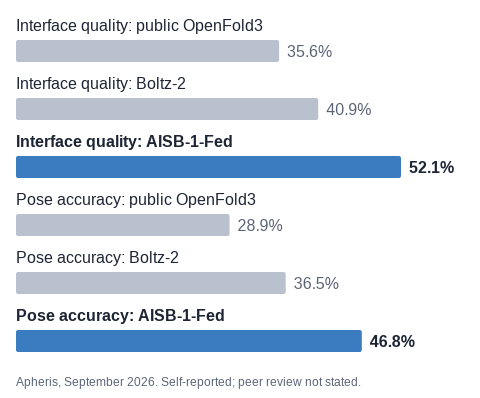
The caveats matter more than the headline. Each partner held out 5% of its structures, and the results are pooled, so no partner-level numbers are published. Public models were not trained on those partners' private structures, so some of the gain is what one would expect. The page says the federated model outperforms "any model fine-tuned on a single partner's data alone" but shows no single-partner results, so that claim cannot be checked. The authors call the work "an early proof of concept with plenty still to do" and say binding affinity was not evaluated. They disclose that the participating companies funded the consortium and that authors at Takeda and Johnson & Johnson hold stock in their employers. The page states no peer review, and it says the structures and trained model weights remain private to the participating companies. The numbers show that fine-tuning on private structures raised a public model's scores on held-out structures from the same partners. Whether the model generalizes to a non-member's chemistry is not something outsiders can test.
Exclusive fine-tunes give one company a model and the public no evidence
The third approach starts from an open model and tunes it for one owner. In a press release of 8 January 2026, Boltz and Pfizer announced a collaboration in which Boltz will refine its open-source Boltz-2 and BoltzGen models on "Pfizer's extensive historical data" to produce "state-of-the-art, exclusive models" for structure prediction, small-molecule affinity and biologics design. The release describes Boltz as a public-benefit company and says Pfizer keeps full ownership of compounds discovered with the models. It gives no financial terms and does not say where training happens. Because the models are private by design, there are no results to read.
Eli Lilly's TuneLab, which BioPharma Dive covered at its launch on 9 September 2025, is a variation in which the model owner hosts the platform. BioPharma Dive reports that Lilly's models draw on its internal research data, that participating biotech companies train them locally through a federated system from Rhino Federated Computing with improvements sent to a central server, and that Lilly can use partners' data to improve its models. About a dozen startups had joined at launch, according to the article. On 9 November 2026, Tamarind Bio announced that it would build and run the inference layer for TuneLab 2.0, with each member company's models in its own private tenancy. That announcement is Tamarind's own, and neither it nor the launch article reports a benchmark of how TuneLab models perform.
For the company that owns the model, this is the strongest position on control, since nobody else can reach a model tuned on its history. The same fact leaves the field with no evidence of how much a private fine-tune adds beyond the open base. A buyer weighing such a deal has the vendor's description of the benefit and no independent test, so we would ask for a held-out comparison on the buyer's own assays, against the open base model, before signing.
Each approach trades privacy, accuracy and control differently
The choice depends on what a company is willing to expose and what it expects to gain. The panels below separate what the public sources document from our own reading.
What you get. Models trained on every member's measurements together. Inductive Bio, which runs a give-to-get consortium, is quoted in Drug Target Review (July 2025) saying the models improved as partners joined.
What you give up. The measurements themselves, anonymized, held by the operator under a legal framework. The consortium's data-use rights and exit terms are not public, and its members are not named. In our reading, this suits standard ADMET assays, where members are less likely to be exposing an advantage.
Most data pooled, least privacy retained, and the public evidence is company statements and a trade-press account.
What you get. A shared model trained across members' data without the data moving. MELLODDY reported aggregated improvements for each of ten partners, markedly higher on pharmacokinetics and safety-panel tasks. Apheris reports a positive median improvement for 5 of 5 ADMET network members and, for a structure model, higher scores on members' held-out private structures.
What you give up. Some privacy, because model updates can leak information about training compounds (see the section below), and some control, because the aggregated model belongs to a group. MELLODDY's authors describe federated learning as carrying non-negligible cost and nonzero risk. The best-documented result is modest, and the larger ones are reported by the organizer.
The best public evidence of the three, though it is modest or self-reported.
What you get. A model tuned on your own history, which the Pfizer release calls "exclusive," built on a base model that stays open. Pfizer keeps ownership of compounds found with its Boltz models, and Tamarind says each TuneLab member's models run in its own private tenancy.
What you give up. Exposure to the developer, in a form that depends on the contract and that the Pfizer announcement does not describe, plus the benefit of other companies' data. No public result shows what a private fine-tune adds over the open base model.
Most control, least public evidence.
Federation lowers exposure but does not remove it
Keeping data in place does not make a shared model safe to release, because a model or its updates can reveal which molecules it was trained on. In a 2022 arXiv preprint, Pejo and colleagues simulated ten participants training a multitask model on partitions of the public ChEMBL database. Their gradient-based attack told with 82.41% average accuracy whether a given compound was in the current training batch, which they rate as "Large" feasibility for a pharma partner who can access the gradients and "almost negligible" for the server, which cannot see them because of secure aggregation. A second attack worked even with secure aggregation: when one participant left mid-training, the signal for that participant's compounds went from 26 positive epochs out of 30 to none, which let an attacker attribute compounds to a specific partner. Combining a larger batch size with zeroing out small gradient values (a threshold of 0.01) lowered both attacks to "Very difficult" in their rating, and thresholding raised accuracy by 3% over the baseline, while they rate the accuracy cost of differential privacy noise as severe. The ten participants were simulated from one public dataset, so this is not a test against a real consortium.
A 2024 preprint by Krüger and colleagues, who include authors from AstraZeneca, attacked ordinary property models that were not federated; the work was published in the Journal of Cheminformatics in March 2025 under the title "Publishing neural networks in drug discovery might compromise training data privacy." The figures are from the preprint, since we could not open the journal text. Using only the model's outputs (a black-box setting), the authors identified 23 of 859 training molecules in a blood-brain-barrier dataset at a false positive rate of zero, where random guessing would identify 2. On the DNA-encoded-library and hERG (cardiac ion channel) datasets, minority-class molecules were easier to find, with a median true positive rate up to 20 times the overall rate for some representations. Models trained on graph representations leaked least, with a median true positive rate on average 66% lower than the other representations. The study covers classification tasks, not regression, and membership inference shows that a molecule was in the training set without reconstructing the data.
Apheris reports its own tests. Its AISB write-up reports data-reconstruction and membership-inference tests under what it describes as attacker-favorable conditions, with true-positive rates of roughly 0.05 to 0.32 at zero false positives, and says the practical risk in realistic conditions is "negligible." Its ADMET page says the shared model is tested against such attacks before release. Both are the operator's statements about its own tests, so a member told its structures are safe would reasonably ask which attack, on which model, and what rate counted as acceptable.
Competition law and contracts decide who may join
Competitors who pool data have to consider EU competition law, and the Commission's 2023 Guidelines on horizontal co-operation agreements discuss data pools in their section on exchanges of information. What follows is our reading of two paragraphs, not legal advice. Paragraph 408 says participants in a reciprocal data-sharing arrangement such as a data pool "should in principle only have access to their own information and the final, aggregated, information of other participants," and that management of a pool can be assigned to a trustee subject to strict confidentiality rules. Paragraph 418 says data-sharing arrangements to which different competitors contribute data "generally do not amount to a restriction of competition by object" if it is established that they have genuine pro-competitive effects meeting the requirements of paragraph 419. Its example is a pool addressing information asymmetry in a non-concentrated market with benefits for consumers, provided the sensitive data exchanged are necessary and proportionate, and it lists measures such as relying on aggregate and historical data, reducing the frequency of exchange, restricting access and setting the arrangement up transparently. The paragraphs concern restrictions by object, are not specific to pharma and do not settle whether a given consortium complies, which is a question for its own counsel.
The public descriptions mention measures of the kind the guidelines discuss, though none of these sources discusses competition law. The IMI said in the 2020 item that the MELLODDY design keeps anyone from knowing which companies' data add to the central model and that blockchain technology "will be used to log all the activities to make sure data has not been improperly accessed." Inductive says it starts from pre-competitive areas, per Drug Target Review. GEN reported that the AISB programme "implements data quality assessments to support fair commercial value exchange for participating parties."
The contract questions that remain are mostly not public. We found no published terms on what happens to a member's contribution when it leaves, or whether a company can keep using a shared model after a deal ends. Apheris says its members co-own the resulting models and the Boltz release says Pfizer keeps its compounds, but those are fragments of the governance that matters. Anyone judging a consortium offer should treat ownership and exit as terms to negotiate, since we found no public terms to compare against.
The public record is thinner than the announcements
The table lists the efforts discussed here and what the linked source says about their results.
| Effort | Approach | What is shared | What is public about results | Source |
|---|---|---|---|---|
| MELLODDY (ten pharma partners) | Federated | Model updates; datasets stayed with each company | Peer-reviewed paper. Eight of ten partners with a median classification gain above 2.5%; larger gains on ADME and panel assays. Data and models unpublished. | Heyndrickx et al. |
| Apheris ADMET Network | Federated | Model weights only | Company page: 5 of 5 members with a positive median gain. One member quoted, no per-member numbers. | Apheris |
| AI Structural Biology network (Apheris with the AlQuraishi lab) | Federated | Model parameters only; 20,167 private structures stayed in place | Apheris web article: 52.1% against 35.6% on partners' held-out structures. Peer review not stated; weights private. | Apheris |
| Inductive Bio consortium | Pooled | Anonymized ADMET measurements, pre-competitive areas | Company statements and a trade-press account. "Dozens" of unnamed companies; no pool size or consortium results for the pooling itself. | Drug Target Review |
| Boltz and Pfizer | Exclusive fine-tune | Pfizer historical data used to refine open models into Pfizer-only models | Press release of 8 January 2026. No results, no terms. | BioSpace |
| Lilly TuneLab | Hosted model | Lilly-trained models; members' updates via a federated system | Launch coverage of 9 September 2025. No benchmark reported. | BioPharma Dive |
| TuneLab 2.0 with Tamarind Bio | Hosted model | Inference in each member's own tenancy | Tamarind's own announcement of 9 November 2026. No results. | Tamarind |
| OpenBind | Open | Everything, publicly | First release (preprint): 925 binding events, 699 compounds, 601 affinity measurements, one target. | bioRxiv preprint |
| ASAP, Polaris and OpenADMET challenge | Open | Sample data public; test compounds undisclosed at launch | Blind challenge announced December 2024. Outcome paper (JCIM, February 2026): 66 participants, 381 submissions. Raw data on Zenodo, CC BY 4.0. | JCIM outcome paper |
9 of 9 shown
The best-documented effort, MELLODDY, reports median gains above 2.5% on its own relative metric for eight of ten partners, and the largest numbers come from the organizers' own pages. MELLODDY and the Apheris results use different metrics and data, so they do not rank the approaches against each other. The larger claims may be right, but a member, a buyer or an investor can only rely on them after asking who built the test set, whether it contains compounds from non-members, what the results are by partner and not only pooled, and which privacy attacks were run and at what rate.
Frequently asked questions
What is federated learning in drug discovery?
Each company trains a shared model on its own data, inside its own systems, and sends only the updated model parameters to be combined. MELLODDY and the Apheris networks use this approach.
Does pooling pharma data improve AI models?
In MELLODDY, the federated study with a peer-reviewed paper, each of ten partners reported aggregated improvements, eight of ten with a median classification gain above 2.5%, and the abstract reports markedly higher improvements on pharmacokinetic and safety-panel tasks. Larger gains reported by consortium operators are measured on the members' own data.
Can a trained model leak its training data?
Yes, to a degree. Published attacks can tell whether a given molecule was in a model's training set, even when only the model's outputs are visible, so shared models need privacy testing before release.
Why do pharma companies not simply share their data?
Measurements reveal chemistry and strategy, and the EU's guidelines on competitor agreements say pool participants should in principle see only their own information and the aggregated information of others. Consortia respond by limiting the pool to standard assays or by keeping the data in place.
Sources and limits
The MELLODDY figures come from Heyndrickx and colleagues and the IMI's November 2020 news item. The Apheris figures come from its ADMET, AISB network and AISB write-up pages, and the March 2025 announcement and Roehm quotation from GEN. Inductive Bio's consortium is described by Drug Target Review and by Inductive's own pages cited above. The Boltz and Pfizer details are from the BioSpace press release, TuneLab's launch from BioPharma Dive, and TuneLab 2.0 from Tamarind's post. OpenBind figures are from the bioRxiv preprint and the Diamond release. The privacy findings are from Pejo and colleagues and Krüger and colleagues, and the competition-law text is from the 2023 Guidelines. The challenge details are from the Polaris announcement, the JCIM outcome paper and the Zenodo record. We could not open the Polaris results page behind Inductive's ranking, and we could not open the journal text of the Krüger paper. We have not run any of these models and have not seen any consortium agreement, and every performance figure is as reported by its authors. Percentage-point differences are our subtraction from the reported figures. The competition-law paragraph is our reading of the guidelines and is not legal advice.