
Evo 2 Explained: What the Nature Paper Shows

Suppose a variant turns up in the noncoding stretch of a gene on your target list, or deep inside an intron where it might disturb splicing. The protein-based predictors most teams reach for first, AlphaMissense among them, cannot score it. Evo 2, the DNA language model from Arc Institute, NVIDIA and academic collaborators, can, and its 2026 Nature paper (volume 652, page 1349) reports that this is where it does best.
We read Evo 2 as a variant-interpretation tool with a specific edge. It is strongest on noncoding, splice and insertion or deletion variants, and it trails protein-focused models on single-letter coding changes. Its design results are proof of concept on small genomes and short regulatory elements, and its builders deliberately kept it from learning the genomes of eukaryotic viruses. We have not run the model. Every score below is as reported by the authors, in the Nature paper or in the February 2025 bioRxiv preprint, and the two differ in a few places that we point out.
Evo 2 reads DNA one letter at a time through a window of a million letters
Evo 2 is trained the way a chat model is, to predict what comes next, except that each token is a single nucleotide, one DNA letter. The paper describes two sizes, 7 billion and 40 billion parameters, and the code repository also lists 1B and 20B checkpoints. The network, StripedHyena 2, mixes three kinds of convolution with attention, and which the supplementary information calls the first multi-hybrid architecture built on input-dependent convolutions. The mix is there for cost: attention becomes expensive as the window grows, and DNA needs long windows to capture regulation that works across distance. At 40 billion parameters the authors report up to a threefold speedup at a one-million-letter context.
Training ran in two phases (Figure 1). Pretraining used windows of 8,192 letters with data weighted toward genic regions, and a multi-stage midtraining phase then stretched the window to one million letters with more whole-genome sequence. In the paper's needle-in-a-haystack test, the model recovered a random 100-letter stretch placed at different positions inside one million letters of random DNA. That shows the long window can be used for recall, but not yet that biology needs it. The supplement also reports a data-composition ablation (a controlled comparison): a 7B model trained on windows of DNA around genes scored 0.891 AUROC on BRCA1 variants, against 0.793 for one trained on whole eukaryotic genomes.
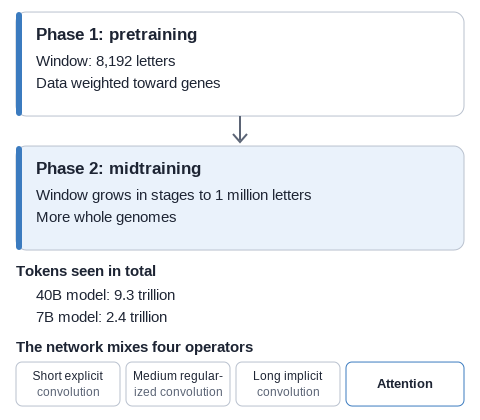
The token counts look inconsistent until the supplement's training table is added up. The Nature text gives 9.3 trillion tokens for the 40B model and 2.4 trillion for the 7B, while the OpenGenome2 dataset card and the supplement give the dataset as 8.8 trillion nucleotides (8.84 trillion). For the 40B model the supplement lists 6.6 trillion tokens at a context of 1,024 letters and 2.1 trillion at 8,192, which is 8.7 trillion of pretraining, and 600 billion more in midtraining brings the total to 9.3 trillion. The February 2025 preprint printed 1.1 trillion for the 8,192 stage, which sums to 8.3 trillion, so that figure appears to have been a typo that the Nature version corrected. Because 9.3 trillion exceeds the 8.8 trillion dataset, some sequence was seen more than once, and the text does not say how much.
Arc's announcement says the data came from more than 128,000 genomes. The supplement says the 40B model trained on 2,048 NVIDIA H100 GPUs for over three months, at a cost of about 2.25 × 10^24 floating-point operations, and Arc's announcement describes this as several months on more than 2,000 H100s.
One exclusion shapes everything that follows. Genomes of viruses that infect eukaryotic hosts were left out of training on purpose, a point we return to below, so "trained on all domains of life" means all domains minus those viruses.
Evo 2 is strongest on variants that protein models cannot score
Evo 2 scores a variant without any labels, by asking whether the mutated sequence looks less probable to the model than the original. The authors first checked that this behaves sensibly: non-synonymous changes, premature stop codons and frameshifts moved the likelihood much more than synonymous ones. The bet is that a change the model finds surprising is more often a damaging one, and the paper tests that bet against clinical labels.
On the most common test, single-letter changes in protein-coding regions from ClinVar (14,319 variants), Evo 2 does not lead. The preprint reports the 40B and 7B models ranking fourth and fifth, behind AlphaMissense, ESM-1b and GPN-MSA, and the Nature text calls them competitive, behind ESM-1b, GPN-MSA and some conservation-based scores but ahead of ESM-2. AlphaMissense is built on protein structure predictions and tuned on the frequency of variants in human and primate populations, and ESM-1b is trained on protein sequences, so both bring information that a model reading DNA alone does not have.
The picture reverses where those models cannot score at all. On coding variants that are not single-letter substitutions, such as insertions and deletions (1,236 variants), both Evo 2 models beat every other method tested, and AlphaMissense and GPN-MSA cannot score these. On noncoding single-letter variants (34,761) the 40B model ranked first among unsupervised models and behind only supervised ones, and on noncoding variants that are not single-letter (3,894) it beat all models tested. For splice effects in SpliceVarDB, which has 1,181 exonic and 3,769 intronic variants, both models ranked first among unsupervised methods. On intronic variants the Nature text puts Evo 2 slightly behind the supervised tools SpliceAI and CADD and ahead of Pangolin. Figure 2 lists these results beside the places where it falls behind, with the version of the paper each number comes from, and the chips filter them.
| Task | Compared against | Evo 2 result | Verdict | Version |
|---|---|---|---|---|
| ClinVar noncoding single-letter variants (n = 34,761) | Other unsupervised and supervised models | 40B ranks first among unsupervised models, behind only supervised ones | Strong | Nature |
| ClinVar noncoding variants that are not single-letter (n = 3,894) | All models tested | 40B beats all | Strong | Nature |
| ClinVar coding variants that are not single-letter (n = 1,236) | All models tested; AlphaMissense and GPN-MSA cannot score these | Both sizes beat all | Strong | Nature and preprint |
| SpliceVarDB, exonic (n = 1,181) and intronic (n = 3,769) | Unsupervised and supervised models | First among unsupervised models; on intronic variants slightly behind SpliceAI and CADD, ahead of Pangolin | Strong | Nature |
| BRCA1 noncoding single-letter variants, zero-shot | Other models | Outperforms all | Strong | Nature and preprint |
| BRCA1, supervised classifier on 40B embeddings | Zero-shot Evo 2 | AUROC 0.95, AUPRC 0.88 (preprint: 0.94 and 0.84 on coding single-letter variants, 0.95 and 0.86 on all single-letter variants) | Strong | Nature; preprint differs |
| Noncoding RNA fitness from deep mutational scans | RNA language models | Competitive in Nature; the preprint calls it state of the art | Competitive | Nature; preprint differs |
| BRCA2 | CADD and others | Second best, behind CADD | Competitive | Nature |
| ClinVar coding single-letter variants (n = 14,319) | AlphaMissense, ESM-1b, GPN-MSA, ESM-2, conservation scores | Fourth and fifth in the preprint, behind AlphaMissense, ESM-1b and GPN-MSA; Nature lists ESM-1b, GPN-MSA and some PhyloP scores ahead | Weaker | Nature and preprint |
| Protein deep mutational scans | ProGen and state-of-the-art protein models | Competitive with ProGen, underperforms the best; gains begin to saturate with scale | Weaker | Nature |
| Distal regulatory variants (dsQTL, DART-Eval) | ChromBPNet | AUROC 0.66 for 40B against 0.89 | Weaker | Nature |
| Variant effects in human-infecting viruses | Other models | Reduced on purpose by excluding eukaryotic viral genomes | By design | Nature and preprint |
12 of 12 shown
The BRCA1 results show how to read the headline numbers. Zero-shot, meaning with no training on labelled variants, Evo 2 outperformed all other models on noncoding BRCA1 variants and beat them when coding and noncoding variants were combined. The supervised result comes from a different experiment, in which a classifier trained on labelled BRCA1 variants sits on top of Evo 2's internal representations (its embeddings). It measures how useful those embeddings are, which is a separate question from how much the model knows unaided. The classifier reached an AUROC of 0.95 in the Nature paper, and a team with labelled variants for its own gene would be repeating this second experiment. For BRCA2 the paper reports second place, behind the supervised model CADD.
The authors are direct about where the model is weak. On protein deep mutational scans, which measure the effect of many single mutations in one protein, it is competitive with ProGen language models but underperforms the best protein models, and the authors write that performance on these fitness benchmarks "begins to saturate" at the largest scales. For distal regulatory variants it falls behind supervised models, with an AUROC of 0.66 for the 40B model against 0.89 for ChromBPNet on the DART-Eval dsQTL task.
One independent check exists, though only as an abstract. Vihaan Mathur and Ravi Sachidanandam have a paper in the NeurIPS 2026 workshop on failure modes of AI in biology, scheduled for 11 December 2026. Its abstract reports that Evo 2 misclassifies pathogenic tRNA variants as benign when only the flanking sequence is altered, and argues that sequence regularity drives its predictions more than biological constraint. We have read only the abstract, so we do not know the numbers or whether the result holds outside tRNA genes.
For a genomics team, the paper suggests a division of labour. For missense variants a protein-focused model is the better first score, and for noncoding, splice and insertion or deletion variants, Evo 2 is a reasonable extra feature beside SpliceAI and CADD, since it is close to them on intronic variants without beating them. A team with its own labelled variants can train a small classifier on the embeddings and test it on genes the classifier has not seen, because the reported BRCA1 classifier was built and tested within one gene.
The embeddings and learned features carry annotation signal that still needs benchmarking
Beyond scoring variants, the paper uses Evo 2's internal representations to read the genome. Lightweight classifiers on 7B embeddings separated exons from introns on eight eukaryotic species held out from classifier training, with AUROCs of 0.91 to 0.99 in the Nature paper (the preprint gave 0.82 to 0.99), and features learned on human and other model organisms transferred to a gene-containing stretch of the woolly mammoth genome. This is the part of the paper most useful for annotating genomes that no one has curated, because the classifier needs no labels from the new species.
The authors also trained a sparse autoencoder, a second small network that explains the model's internal activations through a few active features at a time, on layer 26 of an intermediate 7B checkpoint, using 1 billion tokens of eukaryotic and prokaryotic sequence. Some of the resulting features correspond to exon-intron boundaries and to prophage regions, which are viral genomes integrated into a bacterial chromosome. Across the features, the Nature paper reports recovering 70% of the motifs enriched in promoters from the HOCOMOCO transcription-factor database, against 35% for the HOMER motif-finding tool. These are findings about what the model has represented, and the authors say that systematic benchmarking against established annotation tools is still needed before the features serve as an annotation method.
For a team, then, the embeddings are a usable input to a trained classifier, and the interpretable features are a source of hypotheses to check against known annotation.
Design results are proof of concept on small genomes
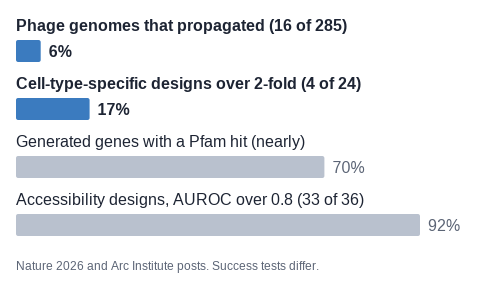
The paper and a separate phage study describe three design efforts, and how well they did depends on how strict each test was (Figure 3). A generated gene with a significant Pfam protein-family hit is a lenient test, and nearly 70% passed. A phage genome that inhibits growth of its host bacterium is a strict one, and 16 of 285 designs, about 6%, passed. The bars measure different things, and they are plotted together only to show how much the success test sets the number.
Tested. Evo 2 was prompted with the start of a genome and asked to continue it: 250 unique 16 kb human-mitochondrial-like sequences, sequences at the 580 kb scale of the minimal bacterium Mycoplasma genitalium from a 10.5 kb prompt, and 20 sequences of 330 kb at the scale of yeast chromosome III.
Found. The mitochondrial sequences had the expected counts of protein-coding genes, tRNAs and rRNAs. Nearly 70% of the M. genitalium-scale genes had a significant Pfam hit, against 18% for Evo 1 131k, and the yeast-scale sequences had predicted tRNAs, promoters and genes with introns, though at lower density than the native chromosome.
The authors: these evaluation metrics "do not guarantee functional or replication-competent genomes."
Tested. Evo 2 proposes 128-letter chunks, and the predictors Enformer and Borzoi score each chunk against a target pattern of open and closed chromatin. A beam search keeps the best chunks and builds on them. The designs were then synthesized and measured in cells.
Found. In mouse embryonic stem cells, designs spelling "LO", "ARC" and "EVO2" in Morse code reached experimental AUROCs of 0.92 to 0.95. In human cells, 33 of 36 designs had an AUROC above 0.8, but only 4 of 24 designs for differential accessibility between K562 and HEK293T cells reached a 2-fold difference, and 1 of 24 reached 3-fold.
The authors describe guided sampling of this kind as computationally intensive.
Tested. In a separate study, from Samuel King and Brian Hie's group, Evo models were fine-tuned on 14,466 Microviridae sequences and asked to write genomes like that of the 5,386-letter, 11-gene phage ΦX174. Candidates were kept only if they encoded at least seven proteins matching ΦX174's and a spike protein at least 60% identical to ΦX174's, then synthesized and tested on E. coli.
Found. Of 302 candidates selected, 285 were assembled, and 16 of those inhibited growth of the target strain E. coli C, while none affected the off-target K-12 strain. The working genomes carried 67 to 392 mutations against known sequences, and mutations in 13 of the generated genomes could not be traced to any known natural sequence.
A Johns Hopkins and Oxford preprint reports 16 viable of 302 candidates (5.3%) at about 97% nucleotide identity to ΦX174.
The phage result has drawn the sharpest argument. The preprint describes one design, Evo-Φ2147, with 392 mutations and 93.0% average nucleotide identity to its nearest natural phage, NC51, and notes that natural genomes below 95% identity to any known phage would typically count as a new species. The study itself was published in Science (volume 393, issue 6811) first published on 6 August 2026 according to Europe PMC, whose abstract reports 16 phages and no other counts. In a bioRxiv preprint from June 2026, James Black, Aaron Maiwald, Jassi Pannu and Oliver Crook analysed the same data. They report 16 viable genomes among 302 candidates (5.3%) at about 97% nucleotide identity to the reference phage, and they concluded that Evo 2's efficiency at finding viable sequences owes more to its outputs staying near known sequences than to exploring new ones, and that its generative abilities warrant low to moderate biosecurity concern. IEEE Spectrum reported on 12 August that the 16 viable genomes were on average about 97 percent identical to their ΦX174 template (Spectrum's wording, not a figure we found in the Science abstract), and quoted Crook, a computational biochemist at Oxford, saying "What we saw, at a very plain view, were brothers and sisters of the original virus." King, the Science paper's first author, told Spectrum that one design's truncated DNA-packaging protein, borrowed from a distantly related phage, is "quite a new configuration."
These accounts are compatible, because an average over 16 genomes and the most divergent single genome measure different things. The pipeline also selected for resemblance. The seven-protein and spike filters kept designs close to ΦX174, and the authors tuned prompt length and sampling temperature to get output that was diverse but still ΦX174-like. We read the full text of the preprint and only the abstract of the Science version, so the counts above are the preprint's. IEEE Spectrum gives the same 302, 285 and 16 for the published paper.
The chromatin result is the strongest evidence that guided generation can hit a target in living cells, and it is also where the hit rate drops once the test asks for something specific. Designing accessibility worked in 33 of 36 cases by AUROC, but designing a pattern that differs between two cell lines produced a 2-fold difference in 4 of 24. Among those four, the predicted motifs were enriched for transcription factors expressed in K562 cells (P = 0.0017) and not for those expressed in HEK293T (P = 0.25). One reading is that the designs worked by making K562 more open and not by making HEK293T more closed. That reading is ours, an inference from the reported numbers, and the authors do not state it.
Taken together, the design results show that Evo 2 plus a scoring model plus search can produce short regulatory sequences with measurable effects, and that fine-tuning on one family can yield working small genomes near that family. They do not show that a team can ask for a bacterial or yeast genome and get a living one, and the authors say that "Experimentally testing genome-scale designs will also require large-scale, iterative effort." In the phage work, 269 of the 285 assembled designs did not inhibit growth, so a team planning design work should plan for a screen in which most candidates fail.
Evo 2 was built to perform poorly on human-infecting viruses
The authors removed the genomes of viruses that infect eukaryotic hosts from the training data to reduce the risk of enabling the design of pathogenic human viruses, and they report that the model behaves accordingly. Perplexity, a measure of how surprised the model is by a sequence, is higher for viral sequences from the USDA Select Agents list than for non-pathogenic viruses and prokaryotic viruses. Mutational effect prediction on human viruses is weaker, and when the authors tried to elicit pathogenic human viral proteins from the model, the generations were "effectively random."
The authors also write that "Task-specific post-training may circumvent this risk mitigation measure and should be approached with caution," which means the safeguard lives in the training data and does not necessarily survive fine-tuning. The phage work fine-tunes on a bacteriophage family, which the exclusion allows, and it is the kind of task adaptation the authors warn about. Arc's one-year post says future biological foundation models will need further alignment work as they become more capable.
For a team working on antivirals, vaccines or viral vectors, the consequence is that Evo 2 should not be expected to score human-infecting viral sequences, and the authors present that as intended. The Nature paper's Extended Data Fig. 2d shows that Evo 2 has ancestry bias similar to other predictors that use no population data, and the authors say this design mitigated bias, so a variant score from the model should not be assumed equally calibrated across ancestries.
What a target-identification or genomics team can take from it
Arc and NVIDIA released the model, the code and the training data, so the claims above can be tested by anyone with the hardware. The repository is licensed Apache-2.0, the OpenGenome2 dataset card lists Apache-2.0, and the Hugging Face model cards for the 7B and 40B weights list Apache-2.0 in their metadata. We did not open the 20B and 1B cards, and the repository README does not state a separate license for the weights.
The compute requirements decide which model a team will run. The 7B checkpoints run in bfloat16 on any supported GPU, while the 40B, 20B and 1B checkpoints need Transformer Engine with FP8 on Hopper-class GPUs, and the 40B needs several H100s. The README says the 20B checkpoint offers 40B-level performance at twice the speed. For teams without that hardware, NVIDIA hosts the 40B model and Arc runs a web tool, Evo Designer.
Arc reports adoption in its one-year post (Figure 5). These are Arc's own counts, and downloads and API requests say little about whether the scores held up in anyone's variant pipeline.
- Citations of the preprint
- 200+
- As of Arc's one-year post, 4 March 2026
- GitHub downloads
- 88,000+
- 380 forks
- Hugging Face API requests
- 2M+ and 6M+
- 7B and 40B models respectively
- OpenGenome2 downloads
- 48,000+
- Figure 5. Arc-reported adoption
The same post lists outside uses that we have not read. Zhu and colleagues scored variants at the APOE locus for Alzheimer's risk. Jiang and colleagues classified variants across farm animal species at an AUROC of 0.921 when blind to variant type and 0.844 when variant types were matched. Fang and colleagues distilled Evo 2 into a compact model, Evo2HiC, that Arc says cuts time and memory for 3D genome analysis by a factor of 500. As of 25 November 2026 we found no announcement of an Evo 3 in Arc's news posts, its Hugging Face organisation or the code repository, whose latest commit is dated 19 June 2026 and adds optional kernels and a gene-completion evaluation.
For a team that wants to try the model, a concrete first step is to run the 7B model on its own variants of the types where Evo 2 is strongest and compare it with the score it already uses. If the team has labelled variants for its own genes, it can train a small classifier on the embeddings and hold out whole genes when testing. Generated sequences should be treated as candidates whose hit rate is set by the strictness of the assay, and the model should not be used for viral work.
Frequently asked questions
What is Evo 2?
Evo 2 is an open DNA language model from Arc Institute, NVIDIA and collaborators, published in Nature in March 2026. It is trained to predict the next nucleotide across genomes from all domains of life except viruses that infect eukaryotes, and it comes in 7B and 40B parameter versions with a one-million-letter context.
Is Evo 2 open source?
The code repository is licensed Apache-2.0, the OpenGenome2 training dataset card lists Apache-2.0, and the Hugging Face model cards for the 7B and 40B weights list Apache-2.0. Check the license files of the specific checkpoint you download.
How accurate is Evo 2 at predicting pathogenic variants?
It depends on the variant type. The authors report the best results among the models they tested for noncoding and non-single-letter variants and, among unsupervised models, for splicing, but protein models such as ESM-1b score ahead of it on coding single-letter variants in ClinVar.
Can Evo 2 design a genome or a virus?
Researchers at Stanford and Arc used fine-tuned Evo models to design ΦX174-like bacteriophage genomes, and 16 of 285 assembled designs inhibited growth of the target bacterium. The model was built to perform poorly on human-infecting viruses, and the paper reports no experimentally tested bacterial or eukaryotic genome design.
Sources and limits
The architecture, training, benchmark and design results come from the Evo 2 paper in Nature, which we read as the open-access PubMed Central text and the Extended Data legends on nature.com, from its supplementary information, which holds the Methods and the training and ablation tables, and from the full text of the February 2025 preprint. Where the two papers differ, for example the BRCA1 supervised scores, the exon classifier range and the 40B token stages, we give both. The Methods and main text disagree on one count that we do not use: the main text says ten 580-kb M. genitalium-scale sequences and the Methods say 35. The genome count and adoption figures are Arc's, from its launch announcement and one-year post, and we have not read the follow-on studies the one-year post cites. The phage counts come from the full text of the bioRxiv preprint of the King and Hie study and from the Europe PMC abstract of the Science version, not the Science full text. The 97% identity figure appears in the Black, Maiwald, Pannu and Crook preprint, which we read in full as a preprint without peer review, and the quotations from Crook and King come from IEEE Spectrum's report. Licenses, checkpoints and hardware requirements come from the code repository, the dataset card and the model cards, and the tRNA finding from the workshop abstract. We have not run Evo 2 or reproduced any score, and all numbers are lab-reported. The explanation of the K562 and HEK293T result as opening one cell line more than closing the other is our inference from the reported numbers.