
What Claude Can Do With Microscopy Images
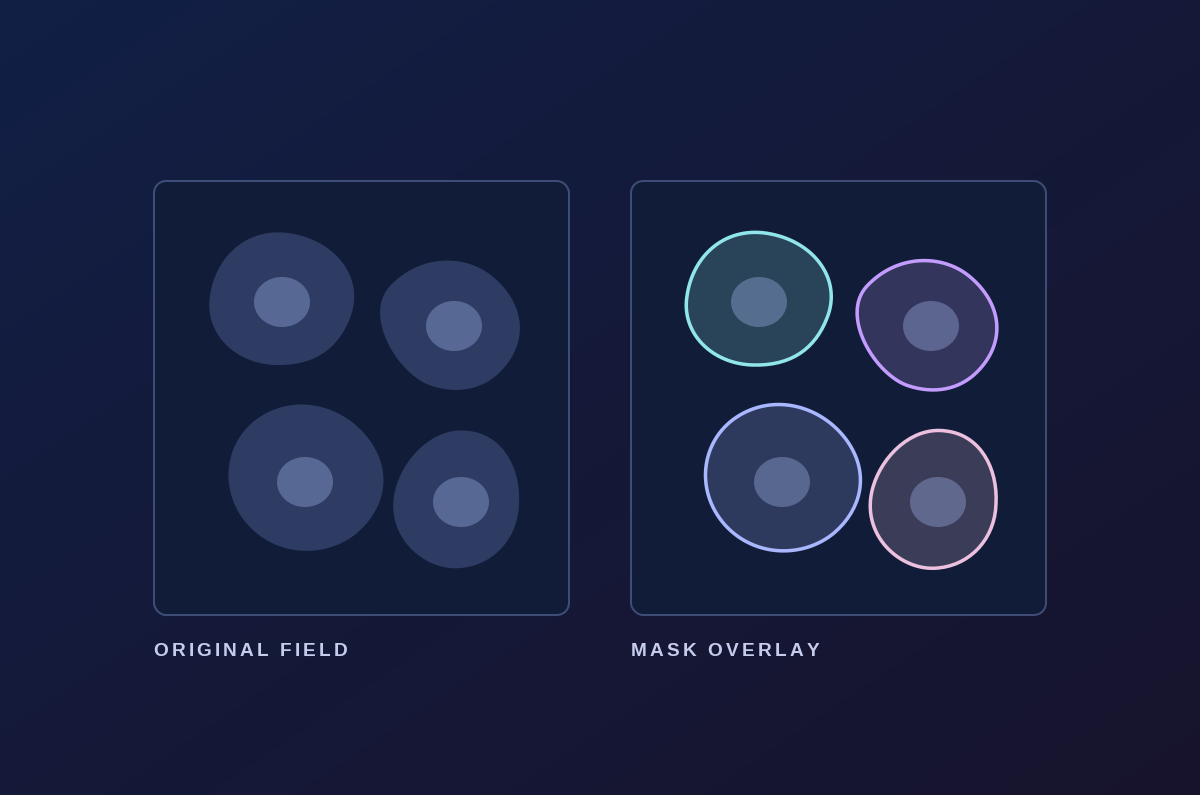
Claude might tell you that the cells in a microscope image look crowded. To report how many cells are in each field, you need to see which cells it counted. Ask for the mask: an image that marks the pixels the software assigned to each cell. Lay it over the original image to spot merged neighbors or missed cells.
Claude can help run and explain that workflow. A specialist tool should produce the masks, tracks and measurements. The distinction matters when a plausible number in a chat window ends up in a lab notebook.
Looking at an image is different from measuring it
Claude can answer questions about an image you attach. That can help you find a legend, describe a visible pattern or decide which field to inspect. Anthropic's vision documentation calls object counts and spatial localization approximate. A screenshot of a fluorescence stack may show only one plane or a projection. It does not preserve the original stack, channel assignments or pixel calibration.
A cell count should point back to labeled objects. A reported area should trace back to a mask and the pixel size. If cells overlap, counts can agree with a hand count even though the software has split one cell and missed another. Look at the overlays as well as the totals.
Claude can call the software that measures the image
Carnation's plugin connects Claude Code or Codex to Carnation's hosted microscopy service. The project describes a helper that uploads the TIFF files you select. A separate service handles the images and Claude works with the results. Check where files go and what your lab permits before pointing the tool at unpublished data.
The Royer Lab's napari MCP connects an assistant to the napari image viewer. The assistant can control the viewer through the connector rather than infer every detail from a screenshot. The viewer can run locally; that alone does not tell you what the assistant client sends to its model provider. Check the connector and client separately. Neither project is an Anthropic imaging model.
Cellpose-SAM and μSAM2 answer different questions
Cellpose-SAM is a useful baseline when you need cell outlines and counts in individual fields. The Cellpose project and its model card list model variants. Record exactly which one you use. Compare its outlines with hand annotations on difficult fields, especially where cells touch, are dim or sit at the edge of the image.
μSAM2, or Segment Anything for Microscopy 2, is a candidate when you need to correct outlines interactively, segment a 3D volume or follow cells across a 2D time series. Its developers released version 2.0.1 on November 19, 2026, the same week as their preprint. The upstream napari plugin uses models trained on microscopy data. Check segmentation and tracking separately: a good outline in each frame does not show that the software followed the same cell across frames.
These are external research tools. The Arca Bio model catalog does not list either microscopy model for inference. The papers and release notes describe what their authors built; they do not tell you which model will work best on your microscope and assay.
Test on held-out images
Start with representative fields that a colleague has annotated. Include crowded and low-contrast images alongside clean ones. Set aside some fields before you tune any settings. Compare count errors per field rather than across the full plate. For masks, compare the outlines with the annotations and review splits and merges. If you intend to track cells, inspect identity changes across frames.
Save the mask or tracks, the source image identifier, the model version and the settings that produced them. Ask Claude to summarize the measured differences and point to fields for review. If a result cannot be traced to an image and an output artifact, leave it out of the notebook until you can verify it. The same distinction applies when evaluating other biological AI models.
This workflow is for research microscopy. It does not establish that Claude can interpret a CT or MRI scan, read a pathology slide for diagnosis, or make a clinical recommendation. Anthropic's vision docs say Claude was not designed to interpret complex diagnostic scans and should not be used for medical advice or diagnosis.