
How to Run BioReason-Pro 2 on Your Own Proteins
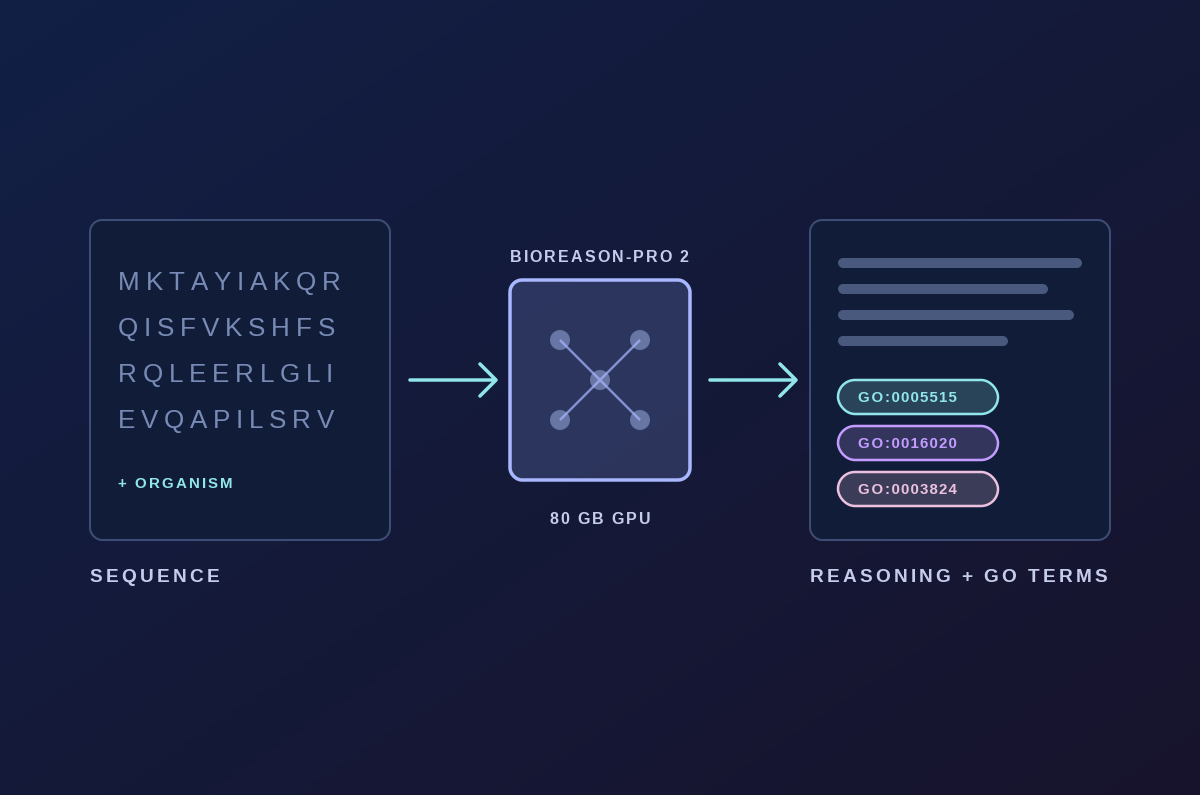
Say you have a list of proteins nobody has characterized, and you want a first guess at what each one does before you plan an experiment. BioReason-Pro 2 is built for that. You give it an amino acid sequence and an organism. It writes out its reasoning, then a list of Gene Ontology (GO) terms, the standard labels for what a protein does and where in the cell. Our read is that it is worth running on your own proteins, and that every answer should be treated as a hypothesis to check. NVIDIA's model card says the same: the outputs are "hypotheses for expert review and experimental validation, not verified annotations."
BioReason-Pro 2 is an open model from NVIDIA, Goodfire and the Arc Institute
NVIDIA released it in November 2026 as a BioNeMo open model. Goodfire described the work on November 24. It follows the original BioReason-Pro.
The model is Qwen3.5-9B, a 9-billion-parameter language model, fine-tuned to read a protein through an ESM3 embedding of its sequence (and its structure, when you supply one). The prompt also carries the organism, GO terms predicted by a separate tool called GO-GPT, and optionally known interaction partners and InterPro domain annotations.
There are two checkpoints on Hugging Face. nvidia/BioReason-Pro-2-9B-SFT is the supervised fine-tuned model. nvidia/BioReason-Pro-2-9B-RL is the same model after reinforcement learning against an LLM judge. The repository's benchmark table scores the RL model higher on every row except one, where the SFT model is ahead by 0.001 in one of the two settings. Start with RL.
It runs on one 80 GB GPU
The repository README says prediction needs one CUDA GPU and that inference fits one 80 GB card, the size of an H100 or an A100-80GB. By default predict.py gives the vLLM inference server 45 percent of the GPU's memory (--gpu_memory_utilization 0.45), and the ESM3 and GO encoders sit outside that share. NVIDIA does not say whether a smaller card works. We have not tried one.
The inference setup from the README:
conda create -n brp-eval python=3.12 -y && conda activate brp-eval
pip install esm==3.4.0 --no-deps
pip install -e ".[eval]"

python scripts/data/download_assets.py --dest assets --skip-structures --skip-ia
python predict.py --input data/examples/proteins.tsv --output runs/example/predictions.tsv
Install esm with --no-deps first, as shown. The first run downloads the checkpoint, ESM3, GO-GPT and GO-GPT's ESM2 encoder. The --skip-structures flag leaves out an AlphaFold structure set of about 150 GB that you only need to reproduce the published benchmark.
predict.py reads a tab-separated file with a header row:
protein_id,organism,sequenceare required. The model reads the first 2,000 residues. Write the organism as UniProt does, for exampleHomo sapiens (Human).taxidis optional. GO-GPT prefers it to the organism name.partnersis an optional list of interaction partner names separated by~.structure_pathis an optional PDB or mmCIF file of chain A.
The models were trained with partners withheld on 80 percent of examples and the structure on 50 percent, so leaving either out is normal use. Add --interpro to include InterPro domain annotations in the prompt. Proteins InterPro has not scanned go to EBI's InterProScan service, which needs a real email address through --email.
Decoding is greedy, with up to 8,000 generated tokens per protein. Each output row holds the full prompt and the response: the model's reasoning, then a summary, InterPro entries, confident and speculated GO terms for each of the three GO aspects, and hypothesized interaction partners. Cells span several lines, so read the file with pandas or csv. The repository includes extract_go_terms to pull the GO identifiers out of a response.
The weights, code and parts carry permissive licenses
| Part | License |
|---|---|
| BioReason-Pro 2 weights (both checkpoints) | OpenMDW-1.1 |
| Code in the NVIDIA-BioNeMo repository | MIT |
| Qwen3.5-9B base model | Apache 2.0 |
| ESM3 open small, the protein encoder (downloaded separately) | MIT |
| GO-GPT (downloaded separately) | MIT |
| Hypothesis Atlas dataset | CC BY 4.0 |
The OpenMDW-1.1 text grants permission to deal in the model materials without restriction. If you distribute them, you keep a copy of the license and the original notices. Rights end if you sue someone claiming the materials infringe a patent or copyright, unless you were first sued. The license puts no restrictions or obligations on outputs. NVIDIA's model card describes the model as ready for commercial or non-commercial use.
The ESM3 line deserves a look because ESM3's open model once carried a non-commercial license. Its Hugging Face card now points to an MIT license, and the esm repository's LICENSE file reads MIT with a 2026 copyright to Chan Zuckerberg Biohub. If you built on an earlier ESM3 release, check which version you have.
Its scores are strong, and its reliability score is the weakest
On the benchmark, a 6,112-protein test split, the RL model reaches an Fmax of 0.662 without InterPro in the prompt and 0.667 with it. Fmax is the best F1 between predicted and true GO terms. An LLM judge, Nemotron 3.5 Super VL, scored a 1,000-protein sample from 1 to 10 on five axes. The RL model averaged 7.74 without InterPro and 8.43 with it.
The axis to read closely is reliability, where the RL model scored 5.34 without InterPro and 6.97 with it, the lowest of the five. The judge is another language model, so these are not lab results. They do say that the answers are specific and usually on topic, and that a confident-sounding explanation is not the same as a correct one.
Goodfire's interpretability work makes the same point from the other direction. It reports that the revision raised the share of annotated sequence features the model identifies from 44 to 84 percent. It also tested two hypotheses in the lab, for SMIM32 and RCDG1. For SMIM32 the model proposed S-acylation at cysteine 75, and the experiment supported it: a signal in the original protein disappeared when that cysteine was replaced. The model's explanation also assigned a signal peptide that Goodfire calls implausible, and named the wrong protein family. A correct conclusion came from partly faulty reasoning. Read the reasoning, not only the GO terms.
Check it on proteins you already know
Before you rely on it for unknown proteins, run it on some whose function you know and compare. The README shows how to score your own labelled proteins with the same CAFA scorer, evals/cafa/cafa_evals.py. Use proteins from your organism or family rather than only the published benchmark, and include some that are poorly annotated.
For each hypothesis you intend to test, check the residues and domains the answer cites against the sequence. The README reports that cited residues are correct about 98 percent of the time, which makes a mismatch worth noticing.
Look up your protein in the Hypothesis Atlas before running anything. It holds 33,533,750 generations from the two models over 300,345 proteins, 61.1 GB in all. Each model has one greedy and 24 sampled generations per prompt. If your protein is in it, you can read the answers now. Our suggestion is to treat agreement across the sampled generations as a cheap consistency check. Agreement shows the model is stable, not that it is right, and disagreement does not rule a hypothesis out: for SMIM32, Goodfire found the S-acylation proposal in 31 percent of 300 sampled responses.
Arca Bio runs open biology models on hosted GPUs through one API. BioReason-Pro 2 is not in the catalog yet.
Sources and limits
The setup, input format and benchmark numbers come from the NVIDIA-BioNeMo/BioReason-Pro-2 README and the model cards for the RL and SFT checkpoints, read on November 27, 2026. The 44 to 84 percent figure and the SMIM32 result come from Goodfire's post. A paper describing the model is still in preparation. We have not run BioReason-Pro 2, so the hardware and setup notes are the authors' and not our measurements. The license summaries are ours, from the license texts, and are not legal advice.