
AI search built for biomedical research
Arca's Max setting scored 84.50 out of 100 on 50 literature questions in our earlier ResearchQA evaluation. The questions asked for short literature reviews, with answers graded against a checklist of required evidence. This is an answer-quality score, not the percentage of relevant papers found.
Arca brings specialist paper search, source reading and cited answers into one research workflow. It is built for questions that need evidence from scientific papers, medical sources and official guidance, with your team's own documents available alongside them.

Results from earlier literature tests
ResearchQA tests whether an answer covers what a literature question asks. Our earlier evaluation used 50 questions and AI graders. Each row below uses those questions with a different Arca setup.
| Arca setting | Score out of 100 |
|---|---|
| Standard Auto settings | 74.48 |
| Extra instructions to seek more evidence | 85.17 |
| Max settings | 84.50 |
| Max plus the extra instructions | 89.44 |
| A later Auto run | 81.44 |
These results show that the model setting and research instructions matter. Max's 84.50 is not a default-product accuracy rate, and the 89.44 run used an extra instruction. Some expected answers still need independent scientific review. Other products were not rerun alongside each Arca change, so this table is not a current head-to-head ranking. See the earlier literature comparison and methods for the setup.
How Arca works through a research question
A web search API helps an application discover pages. The application still needs to decide which sources fit the question, read them and build a supported answer. Arca brings those steps into a research product, with specialist search tools alongside general web search.
| Research step | What Arca supports |
|---|---|
| Find relevant papers | Search PubMed papers by meaning and keywords, with filters for publication year and study type. |
| Look beyond the abstract | Search indexed open-access PubMed Central passages and open available full text to read the methods and results in context. |
| Run a repeatable literature search | Use systematic mode to run and log exact PubMed and Europe PMC queries. |
| Check the answer | Open citations to inspect the supporting source passages. |
| Use your team's evidence | Search and cite documents in your Arca libraries alongside public research. |
For example, you could ask:
What human studies evaluate blood-based biomarkers for early Alzheimer's disease? Compare study populations, sample sizes and diagnostic performance, and cite the supporting passages.
That question needs more than a list of papers. A useful answer has to distinguish human evidence from preclinical work and connect each reported result to the right study. Arca's search filters, full-text tools and citations support that work. This is an example prompt, not a recorded benchmark run; full-text access depends on the source.
Web search remains useful for broad discovery. An AI application built on a web search API can also add readers and specialist tools. A fair comparison needs to account for the whole research workflow.
Research at the scale your questions demand
- Public-source records stored
- 104M+
- As of November 13, 2026
- Text sections prepared for search
- 176M+
- As of November 13, 2026
- Sources listed in our directory
- 227
- Website directory
- Source categories
- 14
- How the directory is organized
Arca's research tools work with a substantial stored public-source collection. Our source directory helps you explore the sources across research areas.
The figures come from our system's running totals on November 13, 2026. Records are stored entries, not necessarily whole papers, and sources can overlap. Text sections are parts of those records, not additional papers. The directory is a separate list, not a count of indexed databases. Collection size does not establish answer quality, freshness or live access to every item.
Biomedical work also crosses into regulatory and legal research. A question about FDA guidance, for example, should distinguish guidance from binding requirements using 21 CFR 10.115 and the FDA's guidance documents. This is an illustration, not a scored task.
More completed tasks in an earlier regulatory benchmark
In the LifeSci Diamond benchmark, Arca passed more tasks than AI assistants supplied with search snippets in all three model groups below. Each comparison used 55 regulatory tasks per system. A pass required every required item to be met without a penalty.
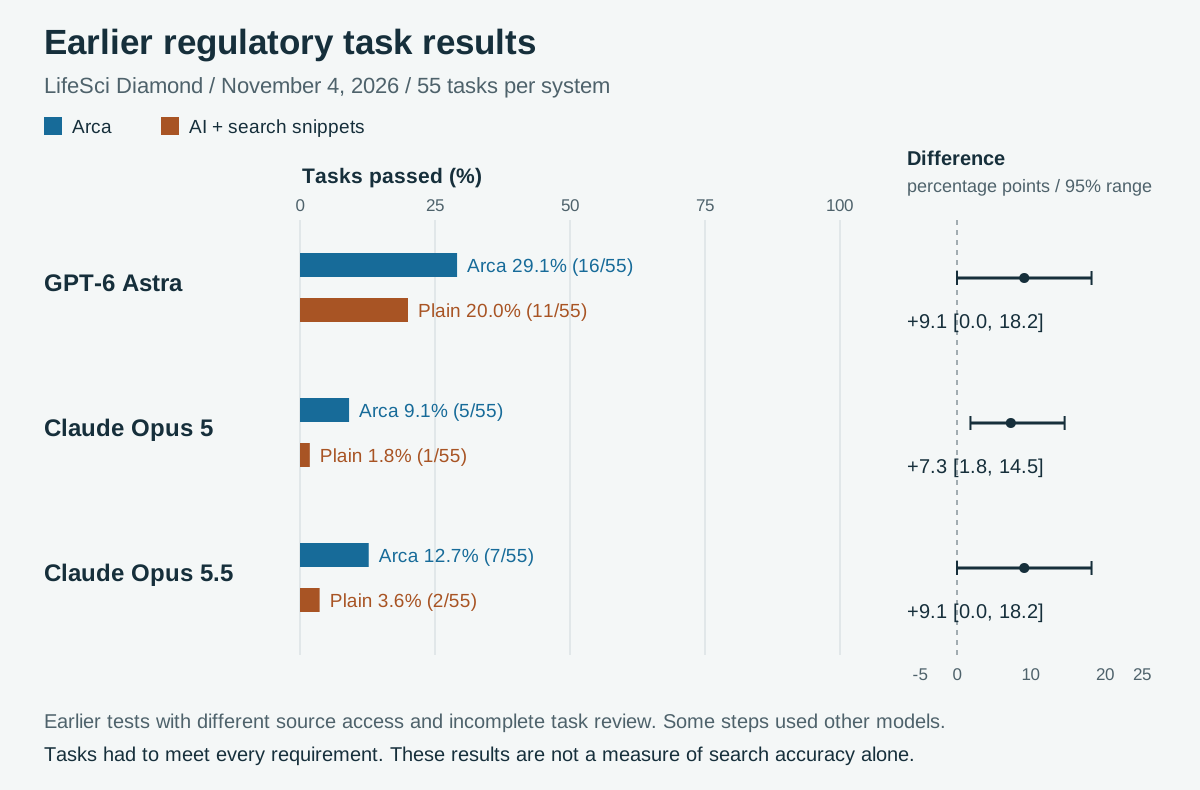
| Model requested | Arca: tasks passed | AI + search snippets: tasks passed | Difference in percentage points (95% range) |
|---|---|---|---|
| GPT-6 Astra | 16/55 (29.1%) | 11/55 (20.0%) | +9.1 [0.0, 18.2] |
| Claude Opus 5 | 5/55 (9.1%) | 1/55 (1.8%) | +7.3 [1.8, 14.5] |
| Claude Opus 5.5 | 7/55 (12.7%) | 2/55 (3.6%) | +9.1 [0.0, 18.2] |
The last column shows the difference in pass rates and its uncertainty. The ranges for GPT-6 Astra and Claude Opus 5.5 include zero, so those comparisons do not establish a clear advantage.
These results measure completed regulatory work, not search accuracy alone. The other assistants received task documents and six short search snippets, but could not open full external pages or PDFs. Model names reflect the requested model, not every step's actual model. Dates, task selection and review were uneven. This is historical context, not a controlled comparison with full web search.
The next comparison: accuracy, completeness, speed and cost
Our next study will compare Arca with an AI assistant using standard web search and full webpage and PDF reading. Both will use the same main model and instructions; Arca will also have its specialist search tools. We will check whether the answers are correct, how much required evidence they cover, how long they take and what they cost.
The head-to-head study has not run yet. The panels below show what we plan to measure, not results we already have.

| What we'll measure | Arca search | Standard web search |
|---|---|---|
| Answer accuracy | Not measured | Not measured |
| Evidence completeness | Not measured | Not measured |
| End-to-end speed | Not measured | Not measured |
| Total serving cost | Not measured | Not measured |
"Not measured" means no result, not zero. The earlier tests do not establish a four-area accuracy, completeness, speed or total-cost advantage. Historical cost records are incomplete; Arca's recorded model cost was higher in the Claude Opus 5.5 comparison.
The pilot will use 20 new questions: five each for scientific literature, medical literature, regulatory guidance and legal research. Each system will answer each question three times: 120 planned attempts, 60 per system. Both will have full-source readers and the same ten-minute limit, without private customer documents or saved answers.
Reviewers will check answers against original sources without knowing which system produced them. Failures and timeouts will stay in the results. Cost will include model calls, searches, reading, retries and a stated share of infrastructure. Grading costs and subscription pricing will be separate.
Questions, independently checked scoring keys and an approved budget are still needed. No new paid benchmark calls have been made. Earlier medical tests compared a component inside Arca, and legal tests do not provide a completed search comparison. The methods explain the evidence behind each result and the next study's design.
Explore the research behind the numbers
The underlying data contains the exact coverage counts and chart values. The methods and source notes include the detailed study plan and the settings behind earlier tests.
The downloads contain no customer documents, protected test questions, private answer keys or credentials.