
AI Agents for Drug Discovery Explained
When Mirror Physics tested its drug-discovery agent Axon, one task asked for a ten-step molecular dynamics simulation in LAMMPS, and the agent ran a hundred steps. Mirror reports this in its January 2026 benchmark post, where the run earned 6 out of 10 for task completion. The slip is small, and it shows where the science sits in an AI agent: the chat model chose a setting, and the simulator computed whatever it was handed. "AI for biology" covers three arrangements that are often confused: a chat model that operates specialist biology tools, a language model trained directly on biological sequences, and a model that helps choose which experiment to run next. We think that in the first of these the chat model supplies planning and convenience while correctness comes from the underlying tool and its inputs, so a buyer should evaluate the tool and the inputs before the chat model.
This guide covers what each arrangement does, what evidence exists for each, which products belong where, and what to ask a vendor. Our earlier guide to biological foundation models describes the specialist models that agents call.
Three different arrangements are sold as AI for biology
In the first arrangement, a chat model such as Claude or GPT is given access to specialist software and asked to use it on a scientist's behalf. Tamarind Bio hosts a library of structure and design models behind a web app, an API and an MCP server, which is a standard way for a chat assistant to call outside tools. Axon, Biomni and Anthropic's Claude Science put an agent on top of such tools. In all of these, the chat model reads the request and decides what to run, and the answer that matters, such as a predicted binding pose or a simulated trajectory, comes from the software it calls.
In the second arrangement there is no tool behind the model. Arc Institute's Evo 2, described in a 2026 Nature paper, was trained on about 9 trillion DNA base pairs, mostly to predict the next nucleotide, and anything it produces comes from patterns it learned from sequences. It has no chat interface unless someone adds one, and its output is judged by whether a laboratory confirms it.
In the third arrangement, a model helps decide what to test next. Google's Co-Scientist, described in a Nature paper, generates, critiques and ranks hypotheses for a researcher. The model's contribution is a choice, and its value depends on what the chosen experiment teaches compared with the alternatives (Figure 1).
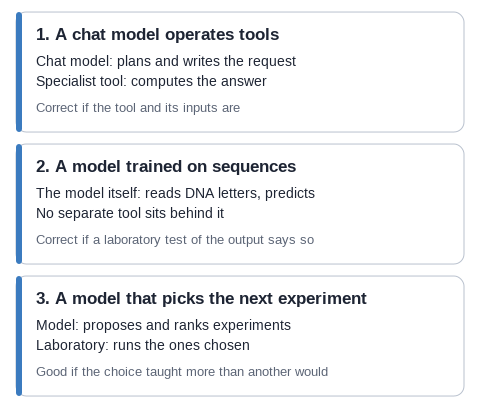
The confusion matters because evidence from one arrangement says little about the others. A strong score for an agent tells you the chat model completed tasks, which does not tell you that Boltz or a docking engine is accurate on your target. A DNA model's result in a laboratory tells you nothing about whether a chat assistant will pick the right settings for a simulation. A buyer who asks "how accurate is the AI?" is asking three different questions, and the first step is to find out which one the vendor is answering.
In an agent, the chat model plans and the tools compute
A single agent run has four steps (Figure 2). The scientist writes a request in plain language. The chat model plans, which means it picks a tool and its settings. The tool runs and produces a result. The chat model then reports back, and a careful scientist reads the log to confirm that what ran matches what was asked.
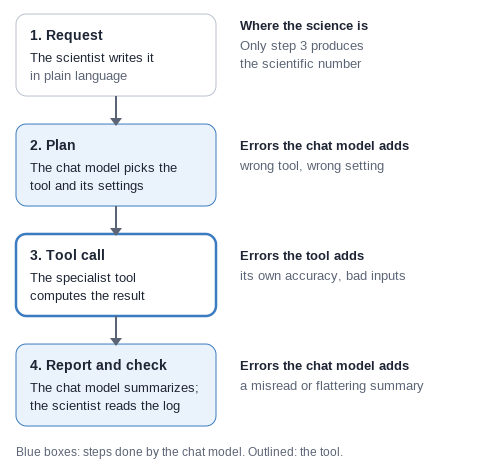
The errors at each step differ in kind. The chat model can pick the wrong tool, mistype a setting or summarize an output too kindly, and those failures show up in a log. The tool's errors are of a different sort. An affinity predictor can be wrong on a new target family for reasons the chat model cannot see, and the chat model will report the number with the same fluency whether the prediction is good or not. This is why the foundation-model guide spends so much time on leakage and on weak spots in tools such as Boltz: they remain whatever agent sits on top.
Products in this group document the plumbing more readily than the accuracy. Tamarind's MCP documentation lists tools to submit protein design and structure-prediction jobs, check their status, download results and upload input files, and its MCP announcement says the company handles the infrastructure. That announcement counts "250+" tools in its library while the homepage says "300+"; the post carries both a 27 March 2026 date and a 9 November 2026 date, so we cannot tell which count is newer, and neither page we read says how the tools were validated. Biomni, a Stanford agent, pairs a language model with 150 tools, 105 software packages and 59 databases that its authors extracted from the literature, according to its 2025 preprint. Its open-source repository warns that Biomni "executes LLM-generated code with full system privileges," which means the agent writes and runs its own code and should be sandboxed. Anthropic launched Claude Science, an AI workbench, in beta on 30 June 2026. It connects to Evo 2, Boltz-2 and OpenFold3 through NVIDIA's BioNeMo and ships with over 60 curated skills and connectors.
For a buyer, the consequence is that an agent's price and interface say little about its accuracy. The accuracy is the accuracy of the underlying tools on the buyer's inputs, so a team that already trusts a tool gets from the agent mainly speed and convenience.
Agent benchmarks mostly measure whether the run finished
The most detailed public comparison of a drug-discovery agent is Mirror Physics' own. Mirror ran Axon and Claude Code on 27 short computational drug-discovery tasks, stopped each run at ten minutes, and had Claude Opus 4.5 read each transcript and any output files to score execution, reasoning and task completion out of 10. It counted a run as successful only at a completion score of 9 or higher. The post's chart caption says 26 tasks and its text says 27, and we use the text. The tiles below give the main numbers.
- Tasks Axon completed
- 26 of 27
- Mirror's own count, from its text
- Tasks Claude Code completed
- 18 of 27
- The comparison agent in Mirror's post
- Who scored the runs
- LLM judge
- Claude Opus 4.5 read transcripts and files
- Scientific correctness was not the criterion
- A success needed a completion score of 9 or more
- Axon's completion score on the LAMMPS task
- 6 of 10
- It ran 100 steps instead of 10
- Claude Code scored 10 of 10 on the same task
These results show that the agent harness matters for completion, since Axon finished 26 tasks to Claude Code's 18, which Mirror presents as 44% more. They do not show that the answers were right. Mirror says its completion score counts whether a task ran "regardless of scientific correctness," and that the tasks "test Axon's executional abilities, not ... the underlying scientific tool." We read this as a fair vendor benchmark of a question worth asking, whether the agent can drive the tools without help, and not as evidence about the models behind them.
The authors of ChemCrow, a GPT-4 agent with 18 chemistry tools, found why the distinction is hard to see in their 2024 Nature Machine Intelligence paper. Four expert chemists compared ChemCrow with GPT-4 alone across 14 tasks and preferred ChemCrow, especially on complex tasks. A GPT-4 grader given the same job favored GPT-4 alone because its answers were more fluent, even when they were less accurate, and the authors call that grader unreliable when factual correctness matters. Mirror's benchmark also uses a language model as the grader, although Mirror is asking about execution and not correctness.
Anthropic's BioMysteryBench is built differently, and it shows what a correctness test looks like. Its 99 expert-written questions ask Claude to analyze real bioinformatics datasets in a container with standard tools, and a run is graded on its final answer, not the method. Up to five experts attempted each question, which left 76 that at least one expert solved and 23 that none did. Anthropic's post shows a headline accuracy falling from 77.4% to 23.5% between those two sets, but it does not name the model for those two figures, so we do not attribute them. For Opus 4.6, the post says the wins on the 23 hard questions were less reliable across five attempts: 44% were reliable wins, against 86% on the solvable set. Anthropic also notes that the hard set is small. Claude Science has no benchmark in its launch post, only anecdotes, such as a UCSF group saying germline workups took roughly a tenth of the time.
So a vendor's headline number should be matched to the question it answers. "Completed 26 of 27 tasks" answers whether the agent can drive tools, and the buyer's own question is whether the answers are right.
The chat model still matters where the task is mostly language
Our argument has a limit, because some biological work has no tool behind it. Troubleshooting a failed experiment from a written protocol, for instance, is done by the language model itself. The UK AI Security Institute's Frontier AI Trends Report says a model first outperformed human experts at troubleshooting wet-lab experiments in mid-2024 and that every frontier model it now tests does so. It adds that the most advanced systems score almost 90% higher than the experts. The report calls 44% the absolute score, but its figure caption gives 44% as the expert baseline for biology troubleshooting, so we cannot tell which score the 44% is. The tasks are graded by language-model judges, and the report says validating those graders remains a significant focus. The report also says non-experts using frontier models to write protocols for recovering a virus had 4.7 times the odds of writing a feasible protocol compared with people using the internet alone (95% confidence interval 2.8 to 7.9), and it states no sample size for that study.
OpenAI's GPT-Rosalind-5.5 shows both the gain and the gating. According to its system card, the model was incrementally trained from GPT-5.5 and is available only to approved customers. On a benchmark the card calls Labwork Bench it scores 63.2% against 55.8% for GPT-5.5, while using fewer tokens, so a chat model with more biology in its training can do better at laboratory reasoning. For DNA sequence design, OpenAI sets an 80% win rate over a baseline called Ledidi as the bar for significant capability and says GPT-Rosalind-5.5 performs significantly below it, which we read as a sign that generating sequences is still better left to models built for it.
So the chat model deserves evaluation, but for the right jobs. Its quality decides whether an agent picks sensible tools and reports accurately, and it decides the answer outright when the task is reading and reasoning about protocols. It does not decide whether a docking score or a predicted structure is right.
A sequence model does its own science, so its evidence is a lab hit rate
A model such as Evo 2 has no tool to blame or credit, which makes its evidence simpler to read and harder to come by. The evidence consists of designs that someone made and tested.
One property attracting attention is in-context learning, where a model adapts to a task from examples placed in its prompt, without further training. In a 2025 arXiv paper, Nathan Breslow and colleagues report that Evo 2 shows log-linear gains in pattern induction as the number of demonstrations in the prompt grows, the same kind of trend seen in language models. Their tasks are controlled symbolic puzzles posed in genomic and linguistic form, not biological design problems, so the paper shows that the ability exists and does not show that it yields working biology. Arc's one-year review of Evo 2 adds that the model outperforms similarly scaled Qwen3 language models on these tasks.
The Evo 2 paper itself reports one laboratory test of design. Its authors used predictive models to steer the model toward DNA with a chosen pattern of accessibility, meaning how open the DNA is to being read, spelled out in Morse-style patterns that included "ARC" and "EVO2", and tested the designs in mouse embryonic stem cells. They report AUROC scores of 0.92 to 0.95 against the intended patterns, where 1.0 is a perfect match and 0.5 is chance.
Arc's own counts show how much a laboratory test changes the picture. Of 285 designed phage genomes that Arc tested, 16 inhibited growth of the target bacterial strain. For epigenomic design, the one-year review reports that 4 of 24 designs produced more than a two-fold difference in accessibility. Arc presents both as proof of concept, and the phage work continued training the model on 14,466 curated phage sequences, so it does not test prompting. These are useful rates, and they are the kind a vendor of a sequence model should be able to quote for its own designs.
Choosing the next experiment is scored by what the lab finds
The third arrangement is the hardest to evaluate, because the output is a recommendation, and a recommendation is only tested by following it. In the Nature paper, Co-Scientist is a multi-agent system built on Gemini 2.0 and coordinated by a supervisor agent. Separate agents generate hypotheses, critique them, rank them in a tournament that scores each hypothesis with an Elo rating, and evolve the winners. Google says most of the system's computation goes to verifying hypotheses, and that it searches the web and databases such as ChEMBL and UniProt.
Reported results come from several laboratories. In liver fibrosis, the paper says the system proposed three epigenetic modifiers with drugs aimed at them, and two of the drugs showed anti-fibrotic activity in human liver organoids without toxicity. Google's post adds that one candidate from Gary Peltz's group blocked 91% of a scarring-linked response in laboratory tests, in work published in Advanced Science. In acute myeloid leukemia, the paper reports that 30 top-ranked drug candidates went to oncologists and that seven drug combinations were tested in two cell lines, with mostly synergistic results in one and mixed results in the other. The paper gives no total for how many hypotheses were generated, and Google's post says only that the system can explore thousands of research directions. The cases therefore show that some proposals held up, and we would not infer an overall hit rate from them.
Google's post also describes a case still waiting for a result: Clare Bryant narrowed a search to specific amino acids that her laboratory will test.
The test for this arrangement is prospective. A team would compare the experiments a model chose with the ones scientists would have chosen, or with random ones, and count what each set taught. We did not find a published comparison of that kind in the sources above, so claims here are best read as plausible and not yet measured.
A short list of documented platforms and the arrangement each belongs to
The table below lists the systems named in this guide, taken from each system's own pages or papers. Kind is the arrangement the system belongs to, and the last column says what the linked source offers as evidence and what it leaves out. The chips filter the rows.
| System | Kind | What it is, per its own pages | Evidence offered |
|---|---|---|---|
| Tamarind Bio | Hosted models | A library of molecular design tools (300+ on its homepage, 250+ in a blog post) behind a web app, API and MCP server | Describes hosting and tool access; no validation or hit rates on the pages we read |
| Mirror Physics Axon | Agent | An agent harness for preclinical drug discovery that runs computational chemistry workflows from plain-language requests | Vendor benchmark of 27 short tasks, LLM-judged, execution and not correctness |
| Biomni | Agent | Open-source (Apache-2.0) Stanford agent with 150 tools, 105 packages and 59 databases in its preprint | Preprint; README warns that LLM-generated code runs with full system privileges |
| Claude Science | Agent | Anthropic workbench in beta (30 June 2026) reaching Evo 2, Boltz-2 and OpenFold3 through NVIDIA BioNeMo | Anecdotes from research groups; no benchmark or accuracy figures in the launch post |
| ChemCrow | Agent | A GPT-4 agent with 18 chemistry tools, 12 of them in the public release | 14 tasks compared by four expert chemists; the authors found an LLM grader unreliable |
| GPT-Rosalind-5.5 | Chat model variant | OpenAI model incrementally trained from GPT-5.5 on biology data, in research preview for approved customers | 63.2% on Labwork Bench against 55.8% for GPT-5.5; significantly below the 80% win-rate bar on DNA sequence design |
| Evo 2 | Trained on sequences | Arc Institute DNA model trained on next-letter prediction, with open weights | 16 of 285 designed phage genomes inhibited growth; 4 of 24 epigenomic designs passed a two-fold accessibility change |
| Co-Scientist | Experiment selection | Google multi-agent Gemini system that generates, critiques and ranks hypotheses, published in Nature in May 2026 | Selected laboratory cases and an Elo benchmark; no total count of hypotheses generated |
8 of 8 shown
The list shows how little of the evidence is shared across rows. The agents offer completion rates or anecdotes, the hosted library offers none, and the sequence and experiment-selection systems offer laboratory cases. A buyer comparing them is comparing different kinds of evidence, and the questions below follow from that.
What to ask a vendor depends on the arrangement
The panels give the questions we would ask for each arrangement, together with the evidence that would answer them.
Ask which tools the agent calls and which versions, because the tool sets the accuracy.
- Which accuracy results exist for those tools on targets like ours, and who ran them?
- Was the benchmark scored on correct answers, or on whether the run finished?
- Who graded it, a person or a language model?
- Where does the code run, and can the agent change files or reach the network?
- Can we see the full log of settings and tool outputs for every run?
Evaluate the tool and its inputs first, then the chat model's reliability at driving it.
Ask for laboratory results, because nothing else can confirm a generated sequence.
- How many designs were made, how many were tested, and how many worked?
- Were the tests run by a group other than the model's authors?
- How close were the working designs to sequences in the training data?
- Does the result come from prompting or from fine-tuning on the team's own data?
The number to ask for is the hit rate per design tested.
Ask how the choices were scored, because a recommendation is only tested by following it.
- Were recommended experiments run, and how many were declined or never tried?
- Compared with what: scientists' choices or random ones?
- How many hypotheses were generated for each one that held up?
- Were the results in silico or in a laboratory?
A good case is anecdote until the denominator is known.
Frequently asked questions
What is an AI agent for drug discovery?
It is a chat model that is given specialist software, such as docking, structure prediction or simulation tools, and plans and runs them from a plain-language request. The scientific result comes from the tools, and the chat model chooses what to run and reports the output.
Is an AI agent the same as a biological foundation model?
No. A foundation model such as Evo 2 is trained on biological data and produces predictions itself, while an agent is a chat model that calls such models and other tools. An agent can call a foundation model, as Claude Science does with Evo 2 and Boltz-2.
How do you evaluate an AI agent for drug discovery?
Test the tools it calls on your own inputs against known answers, then test whether the agent chooses settings correctly and reports what the tool returned. Vendor benchmarks often measure whether a run completed, which says little about accuracy.
Can AI agents run experiments on their own?
The systems documented here run software. In the Co-Scientist cases Google and the paper report, scientists did the laboratory work, and the system proposed which drugs or mechanisms to test.
Sources and limits
The Axon figures come from Mirror Physics' January 2026 post, which is the company's own and which we have not replicated. Tamarind's claims are from its homepage, MCP documentation and announcement post. Biomni is from its preprint and repository, and Claude Science from Anthropic's launch post. ChemCrow is from its Nature Machine Intelligence paper. The BioMysteryBench figures are from Anthropic's write-up, which does not name the model for its 77.4% and 23.5% figures. The wet-lab troubleshooting and protocol figures are from the AI Security Institute's report, whose 44% figure is ambiguous and which states no sample sizes. GPT-Rosalind-5.5 is from OpenAI's system card, where the score tables did not show values for us, so we quote only figures given in the text. The Evo 2 results are from its Nature paper, the Breslow preprint and Arc's one-year review; we read only part of the Evo 2 paper. Co-Scientist is from its Nature paper, which we read in part, and Google's post. We have not run any of these systems, scores are as reported by their authors, and the platform table is a sample of what is publicly documented and not a census.